
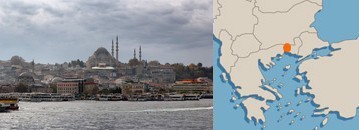

01. Data about the language
The Turkish-speaking population of Greece live in Western Thrace. They are Muslims by religion. During the last two decades, a few thousand Turkish speakers (mostly gypsies) have emigrated to Athens and Thessaliniki urban areas. The vast majority of Muslim gypsies (who lived originally only in Western Thrace) have Turkish as their mother tongue. There is also a small Turkish-speaking community on the Dodecanessa islands.
Hellenised, latinised, and then slavinised ; Thrace received the first arrivals of Turkish people in the XIth century ; migrations continued during the whole Ottoman period. At the end of the war between Greece and Turkey, the Lausanne Treaty of 1923 regulated the population movements in between the two countries. One Muslim minority was allowed in one country and one Christian minority in Turkey. The Muslim minority of Greece includes Turkish people, Muslim Bulgarians (Pomaks) and some of the Gypsies ; its existence is warranted and its rights are officially established.
Updated, sourced data, checked on 14 October 2026 · scope : Grèce (Thrace occidentale) · Get updates for this language
Status
The Treaty of Lausanne (1923) protects the rights of the Muslim minority of Thrace, including freedom of worship and teaching in Turkish1.
02. Poem
Translation: Lingualia (2026)
03. Linguistic description
Turkish is an agglutinative language: a single verb can carry six or seven grammatical categories as suffixes, including negation1. It has no grammatical gender and puts the verb at the end of the sentence1. Its grammar distinguishes what one has witnessed from what one reports or infers1. Tea is çay, from Chinese cha1,2.
Sources
The 2003 CD had no description of this language: this text was written for the site from the sources below.
- WALS Online – Turkish, World Atlas of Language Structures, Max Planck Institute for Evolutionary Anthropology, 2013 (v2026).
- Ö. Dahl, « Tea », chapitre 138 du WALS, World Atlas of Language Structures, Max Planck Institute for Evolutionary Anthropology, 2013.
04. Cartoon
Video hosted on YouTube and published by the channel shown; its author may remove it at any time.