
Languages · Slavic languages

Czech

Spoken in : Austria

01. Data about the language

At a glance

Speakers
11,035 declared speakers (2001 Austrian census, the last to record the language used)1
Education
347 pupils learn Czech at the Komenský school in Vienna (2023–24)1
Identifiers
ISO 639-3 ces · Glottolog czec1258

Language group

Indo-European / Slavic

Area

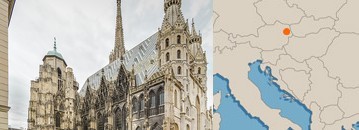
Vienna and in the Lower Austrian (Niederösterreich) regions of Marchfeld and Tullner Feld.

Czech presence in Vienna goes back to the XIIIth century but the total number of people established there increased mainly after the XVIIth century: in 1612 administration and archives from the empire were transferred from Prague to Vienna.

Czech, as a language, was culturally pushed forward after the 1848 revolution. Over more, there were noticeable migrations from Czech workers in between 1880-90 (more than 230 000 people in less than a decade). After the creation of Czechoslovakia in 1918 more than 100 000 returned to their own country.

Between WWI and WWII, Czechoslovakia from Vienna created an important private educational system in their language. After 1945, only 15000-20000 of them decided to return to Czechoslovakia.

Updated, sourced data, checked on 14 October 2026 · scope : Autriche (Vienne) · Get updates for this language

Numerical strength

The last census to record the language of everyday use ("Umgangssprache") was in 2001: 11,035 Austrian citizens then declared Czech1. Register-based censuses, since 2011, no longer collect this information1.

Status

In Austria, the language is protected by Part II of the European Charter for Regional or Minority Languages1. Federal support for the ethnic groups was doubled from 2021 and reached €7.6 million in 2023 for the Federal Chancellery alone1.

Education

In Vienna, the private Komenský school offered Czech teaching to 347 pupils in 2023–24 (381 in 2020–21), 102 of them at primary level1. Czech is also offered in first-language teaching by the Vienna education directorate1.

Media

Since September 2022 the ORF has produced the fortnightly TV magazine "WIR | Češi, Hrvati, Magyarok, Roma, Slováci, Slovenci", broadcast on ORF 2 and ORF III in the ethnic-group languages with German subtitles; in 2024, ORF Burgenland and ORF Carinthia produced about 100 hours of television and over 4,000 hours of radio in these languages1. Since 2021 one "lead medium" per ethnic group has received specific federal funding1. For the Czechs, this lead medium is the fortnightly Videňské svobodné listy; ORF Burgenland broadcasts the TV magazine České Ozveny six times a year, and the weekly radio magazine Radio Dráťak1.

02. Poem

Original Translation
Máj
May
Byl pozdní večer — první máj — večerní máj — byl lásky čas. Hrdliččin zval ku lásce hlas, kde borový zaváněl háj. O lásce šeptal tichý mech; květoucí strom lhal lásky žel, svou lásku slavík růži pěl, růžinu jevil vonný vzdech. Jezero hladké v křovích stinných zvučelo temně tajný bol, břeh je objímal kol a kol; a slunce jasná světů jiných bloudila blankytnými pásky, planoucí tam co slzy lásky. I světy jich v oblohu skvoucí co ve chrám věčné lásky vzešly; až se — milostí k sobě vroucí změnivše se v jiskry hasnoucí — bloudící co milenci sešly. Ouplné lůny krásná tvář — tak bledě jasná, jasně bledá, jak milence milenka hledá — ve růžovou vzplanula zář; na vodách obrazy své zřela a sama k sobě láskou mřela. Dál blyštil bledý dvorů stín, jenž k sobě šly vzdy blíž a blíž, jak v objetí by níž a níž se vinuly v soumraku klín, až posléze šerem v jedno splynou. S nimi se stromy k stromům vinou. — Nejzáze stíní šero hor, tam bříza k boru, k bříze bor se kloní. Vlna za vlnou potokem spěchá. Vře plnou — v čas lásky — láskou každý tvor.
It was late evening — the first of May — an evening in May — the time of love. The turtle-dove's voice called to love, where the pine grove breathed its scent. The silent moss whispered of love; the blossoming tree feigned love's sorrow, the nightingale sang its love to the rose, a fragrant sigh revealed the rose's love. The smooth lake among the shady bushes sounded darkly with a secret pain, its shore embraced it all around; and the bright suns of other worlds wandered along bands of azure, burning there like tears of love. And their worlds, in the shining sky, rose as into a temple of eternal love; until — glowing with love for each other, turned into fading sparks — they met, wandering, like lovers. The full moon's lovely face — so palely bright, so brightly pale, as a girl seeks her lover — flared into a rosy glow; she gazed at her images on the waters and was dying of love for herself. Further off gleamed the pale shadow of the halos, which drew ever closer and closer, as if, embracing, lower and lower they wound into the lap of dusk, until at last they merge into one in the gloom. With them the trees twine with the trees. — Farthest away the gloom of the mountains casts its shade, there the birch to the pine, the pine to the birch bows down. Wave after wave the stream hurries on. Every creature seethes — in the time of love — with full love.
Karel Hynek Mácha (1810-1836)
Excerpt: first stanza of the first canto (1836)
Original text: Czech Wikisource (public domain)
Translation: Lingualia (2026)

03. Linguistic description

Czech, a West Slavic language, has no articles1. Negation is a prefix attached to the verb, and questions are formed through word order1. A single word, ruka, means both 'hand' and 'arm', and tea is čaj, from Chinese cha1,2.

Sources

The 2003 CD had no description of this language: this text was written for the site from the sources below.

  1. WALS Online – Czech, World Atlas of Language Structures, Max Planck Institute for Evolutionary Anthropology, 2013 (v2026).
  2. Ö. Dahl, « Tea », chapitre 138 du WALS, World Atlas of Language Structures, Max Planck Institute for Evolutionary Anthropology, 2013.

04. Cartoon

Bob & Bobek - Králíci z klobouku - V supermarketu
Cartoon · 5 min 59 s · channel: Bonton · YouTube

Video hosted on YouTube and published by the channel shown; its author may remove it at any time.