
Languages · Slavic languages

Macedonian

Spoken in : Greece

01. Data about the language

At a glance

Identifiers
ISO 639-3 mkd · Glottolog mace1250

Language group

Indo-European / Slavic

Area

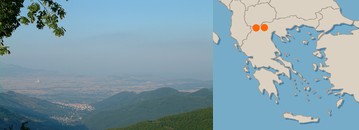
During the first two decades of the century and during the years of the civil war (ended in 1949), a substantial proportion of Slav speakers left their homes to settle down in what is today Bulgaria and the Former Yugoslavian Republic of Macedonia (FYROM). Most of the areas which were then populated by Slav speakers kept Slav speaking groups, namely from the prefecture of Drama to the prefecture of Kastoria. The language is more dynamic in the prefectures of Florina and Pella.

This is the language of the Slavic tribes which settled during the Vith and VIIth century AD on the territories known as Macedonia. After the Balkan war against Ottoman domination, Macedonia was split between Greece, Bulgaria and former Yugoslavia (Clauses of the Bucharest Treaty of 1913). These new borders led to massive migrations: some 100 000 Slavic people left the part of Macedonia that was given to Greece for the North. In the meantime, Greek people from Bulgaria and other countries moved in Greece. Nevertheless, a relevant number of Slavic people decided to stay, and there is nowadays a Slavic minority in Greece. Macedonian was standardized in Yugoslavia since 1944. Linguistically, Macedonian comes from the antique liturgics Slavonic language (existing since at least the Xth century). This make it a close relative to Bulgarian, but with more archaic traits.

02. Poem

Original Translation
Т’га за југ
Longing for the South
Орелски крилја как да си метнех и в наши стâрни да си прелетнех! На наши места ја да си идам, да видам Стамбол, Кукуш да видам,
If I could put on an eagle's wings and fly away to our lands! To go to our own country, to see Istanbul, to see Kukuš,
Да видам дали сâнце и тамо мрачно угревјат, како и вамо. Ако как овде сâнцето ме стретит, ако пак мрачно сâнцето светит:
To see whether the sun there too rises gloomy, as it does here. If the sun greets me as it does here, if there too the sun shines gloomy:
На пâт далечни ја ке се стегнам, и в други стâрни ке си побегнам, каде сâнцето светло угревјат, каде небото ѕвезди посевјат.
I will make ready for a distant road and flee to other lands, where the sun rises bright, where the sky is sown with stars.
Овде је мрачно и мрак м' обвива и темна мâгла земја покрива: мразој и снегој, и пепелници, силни ветришта и вијулици,
Here it is gloomy and darkness wraps me and a dark mist covers the land: frost and snow, and hoarfrost, strong winds and blizzards,
Околу мâгли и мразој земни, а в’гради студој, и мисли темни. Не, ја не можам овде да седам! Не, ја не можам мразој да гледам!
All around, mists and the earth's frosts, and in my breast cold, and dark thoughts. No, I cannot stay here! No, I cannot look upon this frost!
Дајте ми крилја ја да си метнам и в наши стâрни да си прелетнам: на наши места ја да си идам, да видам Охрид, Струга да видам.
Give me wings that I may put them on and fly away to our lands: to go to our own country, to see Ohrid, to see Struga.
Тамо зората греит душата и сâнце светло зајдвит в гората. Тамо дарбите природна сила со сâта раскош ги растурила:
There the dawn warms the soul and the bright sun sets in the forest. There the power of nature has scattered its gifts in all their splendour:
Бистро езеро, гледаш, белеит или од ветар синотемнеит: поле погледниш, или планина -сегде Божева је хубавина.
The clear lake, look, shines white or turns dark blue in the wind; look at the plain, or the mountain: everywhere the beauty of God.
Тамо по срце в кавал да свирам, сâнце да зајдвит, ја да умирам!
There let me play the kaval with all my heart, let the sun set, and let me die!
Константин Миладинов (1830-1862)
Original text: Macedonian Wikisource, after Песни, Skopje, 1986 (public domain)
Translation: Lingualia (2026)

03. Linguistic description

Macedonian is a South Slavic language that long coexisted in the Balkans with unrelated languages1. It tends to lose its case endings, which are replaced by prepositions1. In the western dialects, the definite article, placed after the noun, takes three forms: čovekot, čovekov, čovekon ('the man')1. This system distinguishes a neutral, a proximal and a distal article, which links it to unrelated languages such as Wolof2.

Sources

The 2003 CD had no description of this language: this text was written for the site from the sources below.

  1. M. Markovikj, « Macedonian language tendencies in Balkan context », Université Saints-Cyrille-et-Méthode de Skopje / Slavic Research Center, Hokkaido University.
  2. M. Wahlström, D. Killian, « The Macedonian and Balkan Slavic three-part article and the typology of deictic articles », Journal of Contemporary Philology, University of Helsinki / Université Saints-Cyrille-et-Méthode de Skopje, 2025.

04. Cartoon

Veselite Graskovci Gradinarska izlozba
Cartoon · 5 min 08 s · channel: ТВ Архива МКД · YouTube

Video hosted on YouTube and published by the channel shown; its author may remove it at any time.