
Languages · Germanic languages
Yiddish
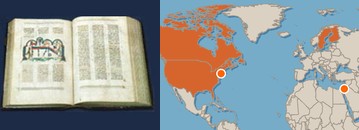
01. Data about the language
Language group
Indo-European / Germanic
Area
NB: The available data covers only the situation of Yiddish in Finland. Yiddish is spoken throughout Europe.
Not limited to any one region.
Yiddish, which is written in Hebrew characters, is a composite language stemming from Judeo-German, that s to say the languages used by the Jews who settled n the Rhine Volley in the Middle Ages. Their vernacular language, based on the local Germanic dialect, has been enriched by numerous contributions from Hebrew and from the Romance languages.
Updated, sourced data, checked on 14 October 2026 · scope : Situation mondiale (Europe, Amériques, Israël)
Numerical strength
Before the Second World War, Yiddish had almost 11 million speakers worldwide, according to the YIVO Institute; it lost most of them, above all through the Holocaust1. YIVO now estimates their number at between half a million and a million, mostly Hasidic and Haredi (strictly Orthodox) Jews in the United States, Canada, Europe and Israel; the UNESCO Atlas of the World's Languages in Danger counts 3 million, based on dated figures (from 1986 for Israel to 2010 for Russia)1.
The language remains an everyday language in Hasidic communities: in the Williamsburg and Borough Park neighbourhoods of Brooklyn (New York) alone, more than 150,000 people have it as their main language, according to a former YIVO education director1. In Europe it has almost disappeared where it once dominated: the 2002 Polish census counted only 37 speakers1.
Status
In Israel, the State chose Modern Hebrew rather than Yiddish as its national language1. In Sweden, Yiddish has been recognised as an official minority language since 2002, and a twenty-year programme aims to preserve it1. In Finland, the Constitution guarantees the Sámi, the Roma and "other groups" the right to maintain and develop their language and culture3.
Education
Media
In Sweden the preservation programme includes radio programmes, amateur theatre and courses in Yiddish; in 2021 the National Theatre staged Beckett's Waiting for Godot in Yiddish1. In Paris, the Maison de la culture yiddish, founded in 2002, produces a twice-monthly programme on contemporary Yiddish culture1.
Miscellaneous
Sources
- M. Pasikowska-Schnass, « Yiddish language and culture and its post-Holocaust fate in Europe » (briefing PE 698.881), Service de recherche du Parlement européen (EPRS), 2022.
- Sweden's 9th Report to the Council of Europe under the European Charter for Regional or Minority Languages, Government Offices of Sweden (Regeringskansliet), Ministry of Culture, 2026.
- Constitution of Finland (731/1999), traduction anglaise non officielle, section 17, Finlex, ministère de la Justice de Finlande, consulté en 2026.
02. Poem
03. Linguistic description
Yiddish is written and read from right to left. Yiddish spelling rules are governed by two codes: one part of the vocabulary is almost completely phonetic in its spelling while another part consisting of vocabulary of Hebrew derivation, retains its original spelling and must be learned as individual lexical items. The twenty-two basic letters of the Hebrew alphabet are used in Yiddish with some letters having added diacritical indicators.
Yiddish is considered to be a fusion language with three major components: Hebrew, German and Slavic. With the continuous migration of its speakers, Yiddish has lived in coexistence with many other languages.
In its initial period, up to the twelfth century, Yiddish was used by the Jews who had come from Romance - speaking areas and settled in the Rhine. Later, Slavic elements, from Polish, Russian, Check and Ukrainian entered the language.
Over a 1000 years Yiddish has been the mother tongue, functioning as both an oral and written expression that communicates its people's hopes and longings. Yiddish has served to connect Jewish communities dispersed around the world.
Early Yiddish literature peaked in the 16th century. Modern Yiddish literature is considered to have begun with the writings of Sholem-Yankev Abramovitch (1834-1917), known as a grand-father of modern literature. Together with Sholem-Aleiolem Rabinovitch (1859-1916) and I.L.Peretz (1852-1915), those three writers were joined and followed by a flourishing community of writers.
Since the end of the World War II, North and South of America, Israel and France have become major centres for Yiddish. Courses are blossoming in Universities and community centres (Institut d'études de Judaisme, Bruxelles; Modern Library, Luft-theatre, Strasbourg), catering to the continued interest and desire that the Yiddish language, literature and culture has to offer.
04. Cartoon
Video hosted on YouTube and published by the channel shown; its author may remove it at any time.