

01. Data about the language
Language group
Indo-European / Slavic
Area
The Croats do not make up the majority population in any of these districts. Compact Croatian regions that are now increasingly becoming bilingual exist only in the Oberpullendorf and Eisenstadt districts.
A substantial segment of the Croatian ethnic group has moved to Vienna, mainly because of economic reasons, like job shortages in Burgenland. Part of this group continues to commute on a weekly basis, the remainder have definitively settled in Vienna. The Burgenland Croats in Vienna are culturally and ethnically well organised.
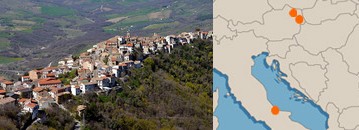
The Croatian ethnic group lives in Burgenland and Vienna. In Burgenland the Croatian ethnic group lives in six of the state's seven districts :
- Neusied/Neusiedl/Niuzalj, - Eisenstadt/Zeljezno, - Mattersburg/Matrstof, - Oberpullendorf/Gornja Pulja, - Oberwart/Borta, - Güssing/Novi Grad.
Updated, sourced data, checked on 14 October 2026 · scope : Autriche (Burgenland)
Numerical strength
Status
In Austria, the language is protected by Parts II and III (Articles 8 to 14) of the European Charter for Regional or Minority Languages within its language area defined by the Ethnic Groups Act (Volksgruppengesetz)1. Federal support for the ethnic groups was doubled from 2021 and reached €7.6 million in 2023 for the Federal Chancellery alone1.
Public services
Education
The Burgenland Minority Schools Act allows every pupil to be taught in Croatian1. In 2023–24, 16% of Burgenland primary pupils (1,812 pupils) were taught in Croatian, against 11% (1,327) in 1995–961. 26 crèches and kindergartens in 24 municipalities care for children in Croatian (1,688 children in 2023–24)1.
Media
Since September 2022 the ORF has produced the fortnightly TV magazine "WIR | Češi, Hrvati, Magyarok, Roma, Slováci, Slovenci", broadcast on ORF 2 and ORF III in the ethnic-group languages with German subtitles; in 2024, ORF Burgenland and ORF Carinthia produced about 100 hours of television and over 4,000 hours of radio in these languages1. Since 2021 one "lead medium" per ethnic group has received specific federal funding1. For the Burgenland Croats, this lead medium is the weekly Hrvatske Novine (€566,000 for 2024–25); ORF Burgenland produces over seven hours of Croatian radio each week1.
Sources
- 6. Bericht der Republik Österreich gemäß Artikel 15 Absatz 1 der Europäischen Charta der Regional- oder Minderheitensprachen (état au 1er octobre 2025), Bundeskanzleramt (Chancellerie fédérale d'Autriche), 2025.
02. Linguistic description
Croatian, a South Slavic language, has no articles, definite or indefinite1. A single word means both 'hand' and 'arm'1. As in other languages that received tea overland, its name (čaj) goes back to Chinese cha1,2.
Sources
The 2003 CD had no description of this language: this text was written for the site from the sources below.
- WALS Online – Serbian-Croatian, World Atlas of Language Structures, Max Planck Institute for Evolutionary Anthropology, 2013 (v2026).
- Ö. Dahl, « Tea », chapitre 138 du WALS, World Atlas of Language Structures, Max Planck Institute for Evolutionary Anthropology, 2013.
03. Cartoon
Video hosted on YouTube and published by the channel shown; its author may remove it at any time.