
01. Data about the language
Language group
Indo-European / Celtic
Area
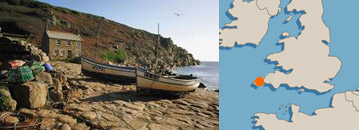
Cornish is being revived in Cornwall.
Cornish has turned into a separate language around the VIIth century AC, when the invasion of the Saxons coming from the East caused the division of the British territory. In the Middle-Age, the Cornish language was at his highest level of development. It is considered that the last native speaker of Cornish died before the end of the XVIIIth, when English definitively took over Cornish.
Updated, sourced data, checked on 14 October 2026 · scope : Royaume-Uni (Cornouailles)
Numerical strength
The 2021 Census has no question on knowledge of Cornish. In England and Wales, 117,350 people identified as Cornish (through the national identity, main language or ethnic group questions); 565 of them did so by giving Cornish as their main language1.
In January 2026, Cornwall Council reported a resurgence of the use of Cornish in everyday life; in the same statement, St Ives MP Andrew George noted that fluent speakers remain "few"2.
Status
Cornish has been protected under Part II of the European Charter for Regional or Minority Languages since 2002. In January 2026, at the UK Government's request, the Council of Europe approved its inclusion under Part III, like Welsh, Gaelic and Manx. The Cornish have been recognised as a national minority since 2014; in December 2025 the Government confirmed a devolution deal recognising this status2.
Public services
The Leader of Cornwall Council, Leigh Frost, cites bilingual signs and the use of Cornish in council meetings, now an "everyday occurrence", among the signs of revival2.
Miscellaneous
The 2026 Lorient Interceltic Festival focuses on Cornish culture2.
Sources
- Cornish identity, England and Wales: Census 2021, Office for National Statistics, 2023.
- Cornish language officially granted Part III status, Cornwall Council, 2026.
02. Poem
translated by the author
Notes from the author:
Eleanor of Provence was said to have composed a song on the love between Tristan, and Iseult the Queen of Cornwall, when she was still a child. She had been promised in marriage to Richard, Earl (or Count) of Cornwall (the home of Tristan and Iseut) and King of Germany, but in the event was given to Richard's brother Henry, King of England.
I imagine her and Richard sailing down the Rhône, perhaps like the lovers in Mistral's 'Isclo d'Or'. It is a warm summer afternoon, as it was on that fateful sea voyage from Ireland to Cornwall when Tristan and Iseult mistakenly drunk the magic potion that made them lovers for ever. It is thought that in Earl Richard's reign the heraldic symbol of the Fifteen Bezants (gold discs, but also the coinage of Consantinople, internationally accepted), became the blazon of Cornwall - which it is to this day. The Cornish flag is the Cross of Saint Piran, white on black.
03. Linguistic description
Cornish is a Celtic language of the Brittonic branch, like Welsh and Breton2. It has a definite article but no indefinite article, and adjectives follow the noun1.
Sources
The 2003 CD had no description of this language: this text was written for the site from the sources below.
- WALS Online – Cornish, World Atlas of Language Structures, Max Planck Institute for Evolutionary Anthropology, 2013 (v2026).
- Glottolog 5.3 – Cornish, Max Planck Institute for Evolutionary Anthropology, 2025.
04. Cartoon
Video hosted on YouTube and published by the channel shown; its author may remove it at any time.