
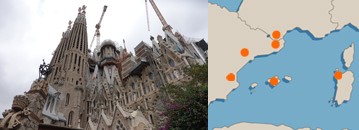

01. Data about the language
Language group
Indo-European / Romance
Area
Catalan is spoken in four Autonomous Communities, viz. Catalonia, the Balearic Islands, Valencia and also in a part of Aragon.
Catalan is a romance language, generally closer to Occitan or French rather than to Spanish (or 'castillan') or Portuguese. It is spoken by over 6 millions of people, in France, in Spain and in the Sardinian village Alghero.
In spite of what could be thought, the dialectal area of the Catalan languages are divided into vertical tapes on an East-West line, and not an North-South. This means that the State border between France and Spain is not a linguistic border for the Catalan language. On the contrary the Catalan spoken in the Balearic Islands (East) belongs to a different dialectal group than the Catalan spoken in Andorra (West).
Catalan is an official language in Andorra.
Updated, sourced data, checked on 14 October 2026 · scope : Espagne (Catalogne, Îles Baléares, Aragon oriental) ; France (Pyrénées-Orientales) ; Italie (Alghero) — Communauté valencienne non actualisée faute de source officielle accessible
Numerical strength
Catalonia: according to the 2023 Survey of Language Use of the Population (Idescat and Generalitat), analysed by the Institut d'Estudis Catalans, 93.4% of residents aged 15 and over understand Catalan, 80.4% can speak it, 84% read it and 65.6% write it; in absolute terms, the number of people able to speak it rose by 267,6001. But Catalan is the habitual language of only 32.6% of the population, against 46.5% for Castilian; habitual bilingual use rose from 7.4% in 2018 to 9.4%1. Nearly a quarter of residents (22.5%) were born abroad; of these, 49.5% cannot speak Catalan1.
Territorial differences (Catalan as exclusive habitual language): from 66.8% in the Terres de l'Ebre to 24.7% in the Barcelona metropolitan area; 26.9% in the city of Barcelona2.
Status
Aragon: Aragonese Law 3/2013 states that Castilian is the official language and recognises the languages of the northern and eastern areas as Aragon's own; the Aragonese Cultural Heritage Act names Aragonese and Catalan of Aragon3.
France: the Constitution states that "the language of the Republic is French" (Art. 2) and that "regional languages belong to the heritage of France" (Art. 75-1)5. France signed the European Charter for Regional or Minority Languages on 7 May 1999, but the Constitutional Council ruled that it contained clauses contrary to the Constitution8. Law no. 2021-641 of 21 May 2021 includes regional languages in the linguistic heritage protected by the Heritage Code6; the Constitutional Council struck down two of its articles, on immersion teaching and on diacritical signs in civil registers7.
Italy: Sardinian Regional Law No. 22 of 3 July 2018 covers Alghero Catalan, to which the Alghero municipal standard applies; its certification follows the Common European Framework of Reference, in agreement with the Sardinian universities and Catalan institutes4.
Public services
France: the 2021 law allows public services to display translations into the regional language on public buildings, roads, transport infrastructure and their main communication materials6; however, the Constitutional Council held that a provision granting individuals a right to use a language other than French in their dealings with the administration was contrary to Article 2 of the Constitution7.
Italy: the 2018 Sardinian law provides for a language desk in Alghero and favours bilingualism in institutional communications4.
Education
France: the 2021 law provides that, under agreements between the State and the regions, the regional language is a subject taught within normal school hours, so that it can be offered to all pupils6.
Aragon: in 2017–2021 the Aragon government had established Catalan teaching posts (7 primary teachers, 5 secondary teachers and 1 official language school teacher)3.
Italy: in the municipalities concerned, schools must include Alghero Catalan in school time, at the families' choice4.
Balearic Islands: Catalan is taught as a subject and used as a medium of instruction in several subjects, alongside Castilian9. In the June 2023 university entrance exams, 67.8% of papers were written in Catalan, 7.4 points down on the previous year and the lowest level since 2006; the share ranges from 49.3% in Ibiza to 91.6% in Menorca and 100% in Formentera9.
Sources
- Informe EULP23 a Catalunya – valoració de l'Enquesta d'usos lingüístics de la població 2023, Institut d'Estudis Catalans (IEC), 2025.
- Enquesta d'usos lingüístics de la població 2023. Resultats territorials, Idescat ; Generalitat de Catalunya, Secretaria de Política Lingüística, 2025.
- Carta Europea de las Lenguas Regionales o Minoritarias – Sexto informe de cumplimiento 2017-2021, Aragón (aragonés y catalán), Gobierno de Aragón, Dirección General de Política Lingüística, 2022.
- Sardaigne – Loi régionale n° 22 du 3 juillet 2018 « Disciplina della politica linguistica regionale », L'aménagement linguistique dans le monde, CEFAN – Université Laval, consulté en 2026.
- Constitution du 4 octobre 1958 (texte intégral en vigueur), Conseil constitutionnel, consulté en 2026.
- Loi n° 2021-641 du 21 mai 2021 relative à la protection patrimoniale des langues régionales et à leur promotion (texte publié au JO n° 119 du 23 mai 2021, reproduit dans le recueil des travaux préparatoires), Légifrance ; ministère de la Culture, 2021.
- Décision n° 2021-818 DC du 21 mai 2021, Conseil constitutionnel, 2021.
- Décision n° 99-412 DC du 15 juin 1999 — Charte européenne des langues régionales ou minoritaires, Conseil constitutionnel, 1999.
- Memòria 2023, bloc III, chapitre 7 « Llengua », Consell Econòmic i Social de les Illes Balears (diffusé par le Centre de Documentació Sociolingüística, Universitat de les Illes Balears), 2024.
02. Poem
03. Linguistic description
Within the Spanish state, the Catalan language is spoken in most parts of the territories corresponding to the Autonomous Communities of Catalonia, Valencia and the Balearic Islands. There also exist other Catalan-speaking areas in neighbouring communities (Aragon and Murcia) but these are not very large ones. In the French state, in the territory known as Northern Catalonia, and in the Italian state (in the city of Alghero, Sardinia), Catalan is also still spoken, although in an increasingly more restricted way. Besides, Catalan is the official language of Andorra. As a whole, its total number of speakers amounts to more than seven million people which, according to official sources, makes it the seventh most spoken language of the European Union. In spite of this data, Catalan is considered a minorised language its tendency to regress has been conspicuous throughout the last decades.
Catalan is one of the several Romance languages that emerged as a consequence of the presence of the Roman civilization in many parts of the European continent. The first written documents that have been found so far date back to the XIth and XIIth century. Catalan is therefore linguistically close to the rest of the romance languages, as shown in this figure:
| French | Occitan | Catalan | Spanish | Portuguese |
|---|---|---|---|---|
| fromage | formatge | formatge | queso | queijo |
| jambe | camba | cama | pierna | perna |
| tête | cap | cap | cabeza | cabeça |
| âge | atge | edat | edad | idade |
| oiseau | ausèth | ocell | pájaro | pássaro |
The Catalan language, according to the traditional classification, is divided in two dialectal subgroups, eastern and western, mutually intelligible.
The spread of the language, from the peninsular northeast towards the south and the Balearic Islands, occurred with the repopulation of the territories that were taken from the Muslims during the XIIIth C. At that time, the Kingdom of Aragon was an important political and military power in the Mediterranean area, whose "official" languages were Aragonese and Catalan. From the XVth C onward, the Spanish (Castilian) language gained predominance in both political and administrative spheres, although Catalan continued to be the language used by most of the population in everyday life.
The successive political changes and those related to the economic domination during the XVIth and XVIIIth C. derived in a loss of preponderance of Catalan in favour of Spanish and French (in the north), specially among the ruling classes.
The political and social movements that developed throughout the XIXth C. as a response to the inflexibility successively shown by the Spanish governments led to a revitalization in terms of language and culture, which was again interrumped by the fascist dictatorship (1939-1975), whose effects are still lasting. Linguistic coexistence between Catalan and Spanish is already a historical fact whose result is always controversial. The measures that have been politically favourable to Catalan throughout the last years of democracy have provided the language with more relevance in some public scopes (education, administration, culture, etc.), although estimates say that nearly half of the Catalan population nowadays has not a Catalan-speaking origin.
04. Cartoon
Video hosted on YouTube and published by the channel shown; its author may remove it at any time.