
Definitions · 3/6
What are these languages for?
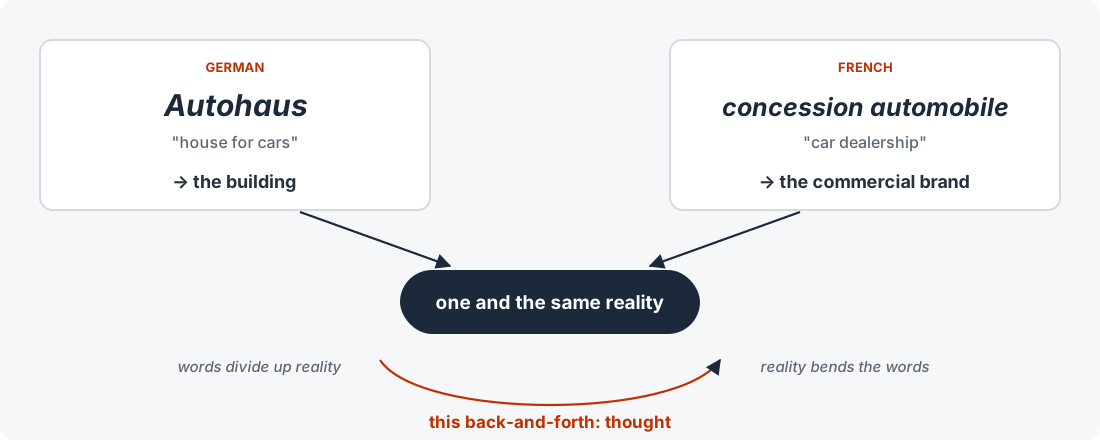
This issue can be dealt with from two viewpoints:
From a scientific viewpoint
Every utterance, even if it is short, corresponds to and enacts a particular reality.Speaking turns out to be a permanent cunning activity that consists in saying or describing a potentially unlimited number of realities in a manner that is constrained by a limited stock of words and specific grammatical rules. To find the right word, in the particular context to describe is therefore a permanent challenge and achievement. In that connection, besides, the stocks of words and possible combinations greatly vary from one language to the other.
The German word 'Autohaus' - that literally means 'car house' - indexes semantic relations that do not exist in the French expression "concession automobile". One can easily refer to the building, the other to the commercial make. Here we can see that the potential for making play on words, the semantic connections that can be conveyed, and the different ways in which the same reality can be perceived, greatly vary between languages. Conversely, the fact that two languages can possess words with connotations so different implies that reality itself, the reality of 'concession' or the reality of 'car house', significantly differs according to particular contexts.
If words do construct a specific reality, they must also comply with that reality.
The relationship between words and the real world is therefore dialectical. This permanent bilateral movement corresponds to the activity of thinking. To find the right word to construe reality is also to construct a certain reality that is dependent on the word used. It is in that sense that it can be said that a language is a specific 'vision of the world',
since a given language enables us to travel back and forth between language and reality,
thanks to and within a set of rules that the given language imposes. Everything can be said in every language, but what is said, the construed reality will always differ from one language to the other.
If a particular way of using language disappears, a particular way of thinking also disappears. One then realises the loss such a disappearance can entail for domains such as scientific research, artistic production or intellectual life in general.
From a political viewpoint:
There is no reason why a particular way of using language should be less valid than another.
No specific way of speaking can be deemed superior to any other way.
To fully endorse language equality constitutes the only means to open a debate about genuine linguistic democracy, and eventually to create a system within which the right to use, transmit and promote one's language, as well as the right to act on the language itself (in the process of defining a standard, in written uses, in word-creating and word-borrowing processes) is guaranteed and regulated.
In practice, multilingualism implies substantial costs and difficulties that cannot be ignored but that can be managed. Yet the fact that a language may only have a limited number of speakers by no means justifies that it should be excluded just like the fact that a person may be sick or poor does not justify that s/he should be socially excluded. Democracy has a price.