

01. Data about the language
Language group
Indo-European / Romance
Area
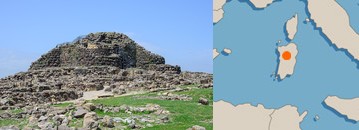
Varieties of Sardinian are spoken throughout Sardinia with the exception of the city of Alghero, where Catalan is spoken.
Updated, sourced data, checked on 14 October 2026 · scope : Italie (Sardaigne)
Numerical strength
The last major regional survey, "Le lingue dei sardi", directed by Anna Oppo for the Sardinia Region, dates from 20072. A more recent university survey of young people shows sharp local differences: about 80% of young respondents in Ogliastra say they understand and speak Sardinian, but just under 50% say they use it; in the Cagliari area, declared active competence reaches only 50%, and 27% have passive competence only2.
Status
Regional Law No. 22 of 3 July 2018 on regional language policy treats Sardinian, Alghero Catalan, Gallurese, Sassarese and Tabarchino as part of the Region's intangible heritage; it applies to Sardinian and Alghero Catalan and provides for the promotion of the other three1. It creates a "Consulta de su sardu" to propose a linguistic standard and spelling norm, taking account of the Campidanese and Logudorese varieties1. Language competence is certified according to the Common European Framework of Reference, in agreement with the Sardinian universities1.
Public services
The 2018 law creates a network of language desks ("sportelli linguistici"): a regional desk, desks in Alghero, Sassari, Gallura and Carloforte, and up to ten territorial desks, handling translation, staff training, multilingual websites and toponymy; their staff must hold at least C1 level1. Regional administrations must favour bilingualism in institutional communications, with the Italian text alone having legal value1.
Education
Media
The Region may fund articles, books, radio and TV programmes and software in these languages, and support broadcasters operating exclusively in them; the law refers to the public broadcasting service contract for the protection of historic minority languages1.
Sources
- Sardaigne – Loi régionale n° 22 du 3 juillet 2018 « Disciplina della politica linguistica regionale » (texte et traduction), L'aménagement linguistique dans le monde, CEFAN – Université Laval, consulté en 2026.
- I. Deiana, « Atteggiamenti e usi linguistici in Ogliastra e a Cagliari », Bollettino di Studi Sardi n° 9, Centro di Studi Filologici Sardi / Università di Cagliari, s.d..
02. Poem
03. Linguistic description
Sardinian is spoken by about 1,300,000 people on the island of Sardinia in the western Mediterranean Sea. Sardinia was one of the first Roman colonies, and, as in other parts of the empire, the spoken Latin of the region gave rise to a Romance language, the first written documentation of which we find in the eleventh century. During the second millennium, Sardinia was first strongly influenced by the presence of Pisa and Genoa and then belonged to Aragon and Spain from the fourteenth to the seventeenth century. In the eighteenth century, it passed to Piemonte and, later, to Italy.
The main problem about Sardinian is the relatively strong dialectal diversity. Basically, as is shown below, we can distinguish between two main groups of varieties, Campidanian in the South and Logudorian in the north. Logudorian also comprises the conservative or archaic central region around the city of Nùgoro. In the extreme north, we find some varieties that can be characterised as semi-Sardinian, due to the strong linguistic influence of Italian during the Middle Ages. Finally, there are two clearly non-Sardinian varieties: Catalan, in the city of L'Alguer on the north-western coast, and Ligurian on some small islands in the south.
It is a longstanding tradition within Romance Philology to characterise Sardinian as the most archaic Romance language, that is to say, the language that has best conserved some Latin elements, for example words that have been lost in all other Romance languages, like DOMUS (srd. domo) or MAGNUS (srd. mannu). Another so-called archaic element is the preservation of the short Latin vowels I and U and the third person singular ending -T.
The socio- linguistics status is that of a minority language before any legal establishment as a regional language. Sardinian is mainly spoken in the villages, in private life (both in the family or for non-official contact within the village community). Italian is the main language in the cities, whereas in the villages it is used for communication with strangers. In this respect, it is notable that Italian is also used to communicate with speakers of distant dialects of Sardinian. Italian is almost the only language used for official purposes.
During the last few years the legal situation has been improved: Sardinian has been officially recognized by the island's local legislation in 1997 and by the Italian State in 1999. As far as the standardisation of Sardinian is concerned, it is evident that the dialectal diversity makes it extremely difficult to find a common standard. Recently, a commission of experts established by the Sardinian Regional Government has been working out a proposal for a unified Sardinian Standard (Limba Sarda Unificata), which has given rise to highly controversial reactions. It is still unclear, whether it will be accepted by the speakers.
04. Cartoon
Video hosted on YouTube and published by the channel shown; its author may remove it at any time.