

01. Data about the language
Language group
Finno-Ugric / Finnish
Area
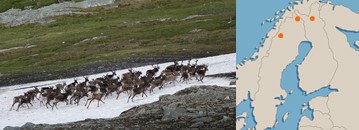
Sami is spoken in the North-West of the country.
The eldest description of Sami (Lapp) was given by Tacit in "De origine et situ Germanorum" (98 AD). Originally Samis lived from hunting and fishing, as small communities. This traditional way of life was modified during the XVII and XVIII centuries, when settlers reached the Northern territories. This settlers were mainly farmers, they were living in houses, they were producing butter and wool. The least we can say, is that this way of life was extremely different from the Sami's traditional activities. Nevertheless, they adapted and integrated . During the XIXth century the creation of a new educational system modified the attitude to Samis and to their culture, and lead to a limitation of the use of "sámegiella", which would afterwards be suppressed.
Updated, sourced data, checked on 14 October 2026 · scope : Suède ; Finlande ; Norvège
Numerical strength
Status
In Sweden, Finnish, Meänkieli and Sami are covered by Part III of the European Charter for Regional or Minority Languages, each with an "administrative area"; since their introduction in 2010, these areas have grown through voluntary affiliation and included 85 municipalities and 15 regions in 20261. In these areas, individuals may use their minority language with the authorities concerned and are entitled to preschool and elderly care wholly or largely in that language1. The Sami Parliament is responsible for language planning and leads work on the language, notably through its Sami Language Centre, whose funding has been increased from 2022 to 20271.
Finland: the 2003 Sámi Language Act (1086/2003) aims to secure the constitutional right of the Sámi to maintain and develop their language and culture; it covers Inari Sámi, Skolt Sámi and Northern Sámi3.
Public services
Finland: a Sámi has the right to use their language in their own matters before the authorities covered by the Act, including the municipal bodies of Enontekiö, Inari, Sodankylä and Utsjoki; an authority may not restrict this right on the grounds that the person also knows Finnish or Swedish3.
Sweden: In these areas, individuals may use their minority language with the authorities concerned and are entitled to preschool and elderly care wholly or largely in that language1.
Education
Sweden: in 2023–24, 395 compulsory-school pupils took mother-tongue tuition in Sami, out of 763 entitled (52%)1. The Sami school has syllabuses in Sami as a first and second language; since 1 July 2024 a track for Sami as a second language for beginners has been added1.
Norway: all Sámi pupils are entitled to Sámi teaching as a first or second language, wherever they live and whatever the number of pupils in the municipality; teaching through Sámi, however, requires at least ten pupils asking for it4. Outside the Sámi language administrative area, many pupils receive it from itinerant teachers (Tromsø, Alta, Bodø) or for a few hours a week at a centralised school (Oslo)4. Sámi teaching is not compulsory, unlike Norwegian4.
Media
Sweden: in 2025, Sveriges Radio, SVT and UR broadcast or provided 1,648 hours of programmes in Sami, about 850 of them first broadcasts; SVT's 2024 Christmas Calendar was set in Sápmi1.
Sources
- Sweden's 9th Report to the Council of Europe under the European Charter for Regional or Minority Languages, Government Offices of Sweden (Regeringskansliet), Ministry of Culture, 2026.
- StatFin, tableau 11rm « Language according to sex by municipality, 1990-2025 » (population au 31 décembre), Statistics Finland (Tilastokeskus), 2026.
- Sámi Language Act (1086/2003), traduction anglaise non officielle, Finlex, ministère de la Justice de Finlande, 2003.
- V. Özerk et L. Somby, « De som berøres må høres – hvem er samisklærerne i grunnskolen? », Sámi logut muitalit / Samiske tall forteller 2025, chapitre 5, Sámi logut muitalit / Samiske tall forteller, rapport 2025, 2025.
02. Linguistic description
Six of ten Sami languages have a written language system: North, Lule, South, Inari, Skolt and Kildin languages. Kildin uses a variant of Cyrillics while others are based on the Latin alphabet.
The majority, up to 75 % of Sami speakers ( about 37 000) , speak North Sami and most of them live in Norway (about 23 000), about 2000 in Finland, about 8 000 in Sweden. The second biggest is Lule Sami spoken by 2000 Samis in Norway and Sweden. South, Inari, Skolt and Kildin Sami have 300 - 800 speakers.
| ENGLISH | NORTH SAMI | FINNISH |
|---|---|---|
| tent | goahti | kota |
| cheese | vuostá | juusto |
| key | čoavdda | avain |
| have been | lea leamaš | on ollut |
| two sheep | guokte sávzza | kaksi lammasta |
The Sami Languages belong to the Finno-Ugric part of the Uralic language family. They are very closed to the Finnic languages among which the Finnish language has been the neighbouring language since the split of the Finno- Samic protolanguage ( about 3200 BC.).
In phonology, the vowel system has undergone a radical reorganization, whereas the consonants system has retained many old features (such as palatalization) which has disappeared in Proto-Finnic.
In morphology Sami has retained the dual number in personal pronouns, personal endings and possessive suffixes, for example personal pronoun I mun (sg), moai (dual), mii (pl). Moai refers to two persons or living things, mun manna 'I go', moai manne we two go, mii mannait we go.
In North Sami the case endings are fewer than in Finnish, because some cases have developed into one, for example Finnish four different cases ( inessive, elative ablative and allative) have developed into one (locative), for example goapis (Finnish kodassa, kodasta, kodalla, kodalta). In North Sami accusative and genitive are identical, as in a word goahti: goapi (AccGenSg) (Fi kodan, kotaa)
The Sami language has consonant gradation which comprises all the consonants whereas in Finnish only the stops alternate. For example, North Sami goahti Nom Sg:goapi GenSg (Sami tent) , gánda Nom Sg:gándda GenSg (boy).
03. Cartoon
Video hosted on YouTube and published by the channel shown; its author may remove it at any time.