

01. Data about the language
Language group
Indo-European / Slavic
Area
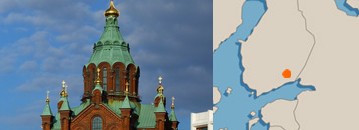
The use of the Russian language is not territorially limited but scattered throughout Finland.
Finland was a Grand-Duchy of the Russian Empire between 1809-1917 and as such we can date Russians presence there from that time. Nevertheless, some Russian merchants and soldiers settled there since the XVIIIth century. The migrations of the XXth century were mainly caused by the Bolshevik revolution.
Updated, sourced data, checked on 14 October 2026 · scope : Finlande
Numerical strength
On 31 December 2025, 102,618 people had Russian as their mother tongue recorded in the Finnish population register, against 72,436 in 20151.
Status
The Finnish Constitution (Section 17) guarantees the Sámi, as an indigenous people, as well as the Roma and "other groups" the right to maintain and develop their own language and culture2.
Sources
- StatFin, tableau 11rm « Language according to sex by municipality, 1990-2025 » (population au 31 décembre), Statistics Finland (Tilastokeskus), 2026.
- Constitution of Finland (731/1999), traduction anglaise non officielle, section 17, Finlex, ministère de la Justice de Finlande, consulté en 2026.
02. Poem
03. Linguistic description
Russian is the official language of Russia and Belarus, and it is the mother tongue of 130 million Russians who live in Russia or in one of the various republics of the IEC. Besides, 16 million non-Russians consider Russian as their mother tongue. Beyond Russia's and the IEC's borders, Russian, which is recognised as one of the official languages of the UN, also enjoys the status of great international language thanks to both Russia's world prestige and to the richness of Russian culture in scientific and literary domains.
Russian is an Indo-European language belonging to the oriental sub-group of the Slavic group. According to their linguistic kinship, modern Slavic languages can be subdivided into 3 groups :
*The oriental group (Russian, Belarussian and Ukrainian) ;
*The occidental group (Polish, Czech, Slovakian, Serbian) ;
*The meridional group (Bulgarian, Macedonian, Croatian, Slovenian).
Words such as mat', brat (brother), sestra (sister), golova (head), rouka (hand), serdtzé(heart), léto(summer), zima (winter), dén' (day), notch' (night), zémlia (earth), voda (water), solntzé (sun), vétér (wind), zéliony (green), zhiolty (yellow), odin (one), dva (two), tri (three), désiat' (ten), iést' (to eat), pit' (to drink), zhit' (to live), khodit' (to walk) etc., are common to almost all Slavic languages. Of course common Slavic lexicon has distinctive phonetic and morphological features according to the language considered, as showed below :
| “to drink” | |
|---|---|
| Russian | pit' |
| Ukrainian | piti |
| Bulgarian | piya |
| Croatian | piti |
| Slovenian | piti |
| Polish | pić |
| Slovakian | piť |
Like all languages, Russian borrowed many words from other European languages : restoran, taksi, metro, adres. Many words were borrowed from Latin and Greek.
Modern literary Russian was born in the middle of the 18th century. Mikhail Vassilyevitch Lomonossov, the great Russian scholar, wrote the first grammar bringing together, into one single system, elements of spoken Russian and Slavonic, the latter being the written language of the orthodox Church that had been elaborated by two monks - Cyrille and Method - in the 9th century. In addition to Russian, the Cyrillic writing system (which was derived from the Greek alphabet) is also used to write Serbian, Slavo-Macedonian, Bulgarian, Ukrainian, and Belarus.
04. Cartoon
Video hosted on YouTube and published by the channel shown; its author may remove it at any time.