

01. Data about the language
Language group
Indo-European / Slavic / Southern / Eastern branch
Area
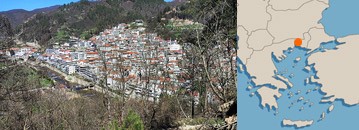
The Pomaks live in Western Thrace (Greece). In the past two decades, a few thousand of them have migrated to the prefecture of Attici. They speak the Rhodope dialect.
The origin of this people is not certain. It has been attested that Slavic people settled in western Thrace from the VIIIth century. They adopted Islam on the XVIIth century. During the Ottmoman time, Pomaks would enjoy a form of autonomy. However, they actively took part into the independance war against Turkey. At the end of the war between Greece and Turkey, the Treaty of Lausanne (1923) ruled the exchanges of populations between the two countries and granted the Moslim minority in Greece and the Greek minority in Turkey with protection measures. The Moslim minority in Greece includes Pomaks, Turkeys and a part of Romas.
Updated, sourced data, checked on 14 October 2026 · scope : Grèce (Thrace occidentale)
Numerical strength
Status
Under the Treaty of Lausanne (1923), the rights of the Muslim minority of Thrace, including the Pomaks, notably freedom of worship and teaching in Turkish, are protected1. Since the 1990s Greece has sought to present the Pomaks as a community distinct from the Turks, but they have received no official recognition as an ethnic minority1.
Education
The author of this study, based on observations in educational institutions, argues for institutionalising minority languages to foster educational success and counter possible language loss1.
02. Poem
03. Linguistic description
THE POMAK LANGUAGE
General Information
The Pomaks live in the region of the Rhodope mountains on both sides of the Greek-Bulgarian border. Their mother tongue is Pomak (Pomachki). The Pomaks, along with Turks and Muslim Roma living in Thrace, are officially recognized as a religious Muslim minority, in accordance with the Treaty of Lausanne (1923). The religious services of the Pomaks are held in Arabic.
The Pomak language belongs to the linguistic family of the Southern Slavic languages and has a lot of similarities with the Bulgarian language. It also incorporates many Turkish loan words and certain Greek loan words. There have been various written transcriptions of the oral traditions of the Pomak language, although different transcription forms have been used up to now.
Songs, proverbs, fairy tales and everyday phrases have been published in various books and numerous recordings of Pomak folk songs have been released. Besides the dictionaries and courebooks that have been published, there are also linguistic studies of the language and Ph.D theses under way. A Pomak newspaper called "Zagálisa" is currently published in Greece. A cultural Organisation called Pomak Research Centre (based in Komotini-Greece) is promoting research on the Pomak lanuage and culture. Variations of Pomak dialects have not been analysed and compared yet.
Linguistic Description
The vowels and consonants used by dictionaries and Pomak researchers up to now are represented in the Alphabet table below. The /d/ and /?/ sounds do not exist in Pomak. The structure and syntax of the Pomak language is mainly Slavic and so is most of its vocabulary. There are three grammatical genders, two numbers, and four cases (Nominative, Genitive, Accusative, Vocative). The definite article is attached to the noun as an ending. Masculine nouns end in a consonant, feminine nouns end in -a or -o and neutral nouns end in -e, -o, or -u. Those feminine nouns which derive from a corresponding masculine noun end in -a, -na, -ka, -ova, -inka, -itsa. Diminutives are very common in Pomak. Compound words are not many, as the Pomaks would rather use a combination of words rather than a single compound word. Pronouns are inflected like nouns and adjectives. Adjectives and adverbs formulate the comparative degree using "po" (more)- e.g. po hubava (better). The superlative degree is formulated with "jáche". The only auxiliary verb is the verb "sam" (be). The verb "ímam" (have) is not used as an auxiliary one. There are three one-word tenses (Present, Past Simple, Past Progressive) and five periphrastic tenses (Present Perfect, Past Perfect, Future Simple, Future Progressive and Future Perfect). Future tenses are introduced with "she" (will). There is also a tense called "Future in the Past". There are two types of Participles (Present and Past Participle). Verbs are divided into two groups: those ending in -am or -om and those ending in -em. The Passive Voice is formulated with the addition of "sa" in the Active Voice form. The negative verb forms are created by adding "ne", "ni" or "nie" in front of the verb. Interrogative forms are the same as the Affirmative forms with an interrogative intonation. Whenever there is no interrogative pronoun preceding the verb "li" is used.
Vocabulary
The vocabury of Pomak consists of many words that do not appear in other languages. Pomak - Greek dictionaries have recorded more than 20.000 words in their entries. Among them there are many examples of loan words:
| FROM BULGARIAN | FROM TURKISH | FROM GREEK |
|---|---|---|
| vóda (water) | yavás (slowly) | dáskal (teacher) |
| brat (brother) | kitap (book) | drum (street) |
| kósta (house) | taze (fresh) | aresvam (like) |
| shápka (bonnet) | rienk (colour) | hóro (dance) |
| vídem (see) | yasák ye (forbidden) | alá (but) |
| bólan (sick) | óti (because) | |
| dete (child) | ||
| lyubem (kiss) |
There are also many European words which were recently introduced in the Pomak language (eg fabriki= factories, avkátin=lawyer, futugrafichkata makína = photo camera).
Bibliography
04. Cartoon
No cartoon in this language could be found on public video platforms.