

01. Data about the language
Language group
Indo-European / Romance
Area
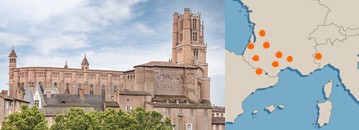
Occitan is spoken in the south of France, in an area comprising 31 'Départements', as well as in Spain, in the Catalan region of Val d'Aran. It is also spoken in the Italian Piemont and in several areas of southern Italy.
Occitan is a Romance language. There are three main varieties of Occitan: northern Occitan, which comprises Limousin, Auvergnat and Alpine Provençal, central or southern Occitan, which comprises Languedocien and Provençal, and Gascon.
Updated, sourced data, checked on 14 October 2026 · scope : France (Nouvelle-Aquitaine, Occitanie) ; Espagne (Val d'Aran) ; Italie (vallées occitanes du Piémont)
Numerical strength
France and the Val d'Aran: according to the 2020 sociolinguistic survey of the Office public de la langue occitane (8,000 respondents in Nouvelle-Aquitaine, Occitanie and the Val d'Aran), Occitan has some 542,000 speakers aged 15 and over1. Only 7% of respondents still speak it, a drop of 3 to 4 points in ten years, but 43% say they understand at least a little1. Speakers are on average 66 years old; 70% learned it in the family1. The departments with the most teaching have the highest rates: Pyrénées-Atlantiques (12%), Aveyron (18%), Lozère (22%)1.
Val d'Aran (2023): 79.7% of residents aged 15 and over understand Aranese, 53.6% speak it, 63.7% read it and 39.4% write it; it is the exclusive first language of 18.5% and the exclusive habitual language of 16.3%8.
Italy: the number of speakers is unknown; the population of the Italian Occitan area is about 100,0003.
Status
France: the Constitution states that "the language of the Republic is French" (Art. 2) and that "regional languages belong to the heritage of France" (Art. 75-1)4. France signed the European Charter for Regional or Minority Languages on 7 May 1999, but the Constitutional Council ruled that it contained clauses contrary to the Constitution7. Law no. 2021-641 of 21 May 2021 includes regional languages in the linguistic heritage protected by the Heritage Code5; the Constitutional Council struck down two of its articles, on immersion teaching and on diacritical signs in civil registers6.
Spain: Catalan Law 35/2010 makes Occitan, known as Aranese in the Val d'Aran, the language proper to Aran and an official language in Catalonia2. In 2018 the Constitutional Court (ruling 11/2018) annulled the provisions making Aranese the language of "preferential" use of institutions2.
Italy: the Occitan community is recognised as a historic linguistic minority by Law 482/1999; Italy has signed the European Charter without ratifying it3.
Public services
France: the 2021 law allows public services to display translations into the regional language on public buildings, roads, transport infrastructure and their main communication materials5; however, the Constitutional Council held that a provision granting individuals a right to use a language other than French in their dealings with the administration was contrary to Article 2 of the Constitution6.
Val d'Aran: Aranese is to be used normally in procedures of the Conselh Generau d'Aran and local authorities, and by the Generalitat in its dealings with citizens in Aran2.
Education
France: the 2021 law provides that, under agreements between the State and the regions, the regional language is a subject taught within normal school hours, so that it can be offered to all pupils5. According to the 2020 survey, 14% of parents of children under 18 say their children take or have taken Occitan classes, and 81% of residents support teaching from nursery to upper-secondary school1.
Val d'Aran: Aranese is the usual medium of instruction and learning in schools2.
Italy: few schools offer Occitan; the Mercator centre lists five comprehensive institutes (Cervasca, Paesana, Villar Perosa, Ceres, Corigliano d'Otranto)3.
Media
France: Occitan is mostly read in the local press (66% of readers); two-thirds of residents want a stronger presence in the media, and streaming and podcast platforms are a source of news in Occitan for 62% of speakers under 301.
Val d'Aran: licensed audiovisual services in Aran must guarantee the presence of Aranese in their programming2.
Italy: several periodicals, including Coumboscuro (a monthly bilingual Provençal–Italian publication), La Valaddo and Ousitanio Vivo, publish 10 to 30% of their texts in Occitan3.
Sources
- La langue occitane : on en parle ! Résultats de l'enquête sociolinguistique 2020 (communiqué du 31 août 2020), Office public de la langue occitane (OPLO), 2020.
- Ley 35/2010, de 1 de octubre, del occitano, aranés en Arán (texto consolidado), Boletín Oficial del Estado, 2018.
- Occitan in Italy (Mercator Wiki), Mercator European Research Centre on Multilingualism and Language Learning (Fryske Akademy), mis à jour en 2026.
- Constitution du 4 octobre 1958 (texte intégral en vigueur), Conseil constitutionnel, consulté en 2026.
- Loi n° 2021-641 du 21 mai 2021 relative à la protection patrimoniale des langues régionales et à leur promotion (texte publié au JO n° 119 du 23 mai 2021, reproduit dans le recueil des travaux préparatoires), Légifrance ; ministère de la Culture, 2021.
- Décision n° 2021-818 DC du 21 mai 2021, Conseil constitutionnel, 2021.
- Décision n° 99-412 DC du 15 juin 1999 — Charte européenne des langues régionales ou minoritaires, Conseil constitutionnel, 1999.
- Enquesta d'usos lingüístics de la població 2023. Resultats territorials, Idescat ; Generalitat de Catalunya, Secretaria de Política Lingüística, 2025.
02. Poem
03. Linguistic description
Occitan is a Romance language (like French, Spanish or Italian) which is linguistically close to Catalan. The geographical area on which it is spoken encompasses thirty odd départements of southern France, but Occitan is also spoken in about twelve valleys in Italy (Piedmont) and in Spain, as well as in the Val of Aran where it has been an official language since 1990.
Provençal is a variety of Occitan. It is spoken in a large part of the Gard département and in the Provence-Alpes-Côte d'Azur region. Some of the masterpieces of Occitan literature were written in Provençal in the 19th and 20th centuries.
In addition to central Occitan (i.e. Languedocien), Ocean's other main varieties are Gascon and northern Occitan.
During the Middle-Ages, from the 11th to the 13th century, Occitan was the language of troubadours. These poets, amongst whom there were also women (i.e. the trobairitz), used to sing moving, lyrical celebrations of love and love sufferings, as well as of nature and war. Of course Occitan troubadours, from Guilhem IX of Aquitània to Bernart of Ventadorn and Guiraut Riquier, did not invent love but 'they contributed] to Europe's sentimental education.' It is also in Occitan that the very first occidental grammar was drafted (Rares de Trobar, XIIe s.). This period indeed corresponded to the golden age of Occitan literature.
A great language of culture during the Middle-Ages, Occitan's use for administrative and judiciary matters persisted until 1539 (Edict of Villers-Cotterêts). Thenceforth, its prestige decreased rapidly; this was the time of the lengo mes presada - the despised language - but it remained the daily language of a very large majority of people. Jules Ferry's school and concomitant French policies of gallicization at the end of the nineteenth century constituted a severe blow to the use of Occitan. Until recent times it has only survived in rural areas, and today its use is rarer and rarer.
Still, within the confines of the Languedoc-Roussillon region, 48% can understand it and more or less 28% speak it (according to a poll conducted by Média Pluriel Méditerranée , 1991).
The spelling system of Occitan is rather old as it dates back to the time of 'troubadours'. This system differs from the French spelling system in significant ways:
Getting started
| Occitan | English |
|---|---|
| Bonjorn ! | Hello ! |
| Cossi va ? | How are you ? |
| Va plan. | I'm fine. |
| E tu ? | How about you ? |
| Adieusiatz | form of greeting: hello or goodbye. |
| Merce plan. | Thanks a lot. |
| Soi tot desvariat. | I am confused. |
| Soi tota desvariada. | I am confused. |
| Cala-te ! | Shut up ! |
| Quina calor ! | It is so hot ! |
| Quin rambalh ! | What a mess ! |
| Adieu ! | form of greeting: hello or goodbye |
04. Cartoon
Video hosted on YouTube and published by the channel shown; its author may remove it at any time.