

01. Data about the language
Language group
Indo-European / Germanic
Area
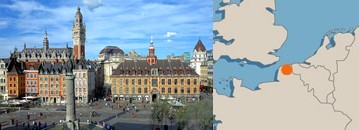
Apart from the Netherlands and Flanders, Dutch (or the dialectal variant of the area) is also spoken in the extreme north of France (Westhoek).
The territory was part of the medieval county of Flanders from 892. Between 1659 and 1678, the area was conquered upon Spain (that was owning Netherlands) by Louis XIV, king of France, and annexed to France. Dutch remained the literature and administrative language up to the French Revolution.
Updated, sourced data, checked on 14 October 2026 · scope : France (Flandre française, département du Nord)
Status
France: the Constitution states that "the language of the Republic is French" (Art. 2) and that "regional languages belong to the heritage of France" (Art. 75-1)3. France signed the European Charter for Regional or Minority Languages on 7 May 1999, but the Constitutional Council ruled that it contained clauses contrary to the Constitution6. Law no. 2021-641 of 21 May 2021 includes regional languages in the linguistic heritage protected by the Heritage Code4; the Constitutional Council struck down two of its articles, on immersion teaching and on diacritical signs in civil registers5.
The former Nord-Pas-de-Calais Region did not support Flemish; since the 2016 merger, the Hauts-de-France Region has given it new support1. The language pact signed in 2020 by the Ministry of Culture, the Region and two local authorities, for three renewable years, commits the Region to supporting the creation of a public office for West Flemish2. In 2025 the Region was working on the design of this office and funding the association Akademie voor Nuuze Vlaemsche Taele – Institut de la langue régionale flamande1. Advocates of West Flemish reject its classification as a dialect of Dutch1.
Public services
France: the 2021 law allows public services to display translations into the regional language on public buildings, roads, transport infrastructure and their main communication materials4; however, the Constitutional Council held that a provision granting individuals a right to use a language other than French in their dealings with the administration was contrary to Article 2 of the Constitution5. Municipalities are the main actors giving Flemish visibility in public space, through bilingual signage1.
Education
France: the 2021 law provides that, under agreements between the State and the regions, the regional language is a subject taught within normal school hours, so that it can be offered to all pupils4. Following this law, a Ministry of Education circular has allowed West Flemish to be taught at school since 2021; the associations, the only bodies with sufficient knowledge of the language, have become an essential support in organising this teaching1.
Sources
- N. Caput, « La région, une échelle de valorisation des langues minoritaires ? La cause du picard et du flamand occidental en Hauts-de-France » (thèse de géographie, avis de soutenance et résumé), Université d'Artois, 2025.
- Signature d'un pacte linguistique dans les Hauts-de-France, Ministère de la Culture, DRAC Hauts-de-France, 2020.
- Constitution du 4 octobre 1958 (texte intégral en vigueur), Conseil constitutionnel, consulté en 2026.
- Loi n° 2021-641 du 21 mai 2021 relative à la protection patrimoniale des langues régionales et à leur promotion (texte publié au JO n° 119 du 23 mai 2021, reproduit dans le recueil des travaux préparatoires), Légifrance ; ministère de la Culture, 2021.
- Décision n° 2021-818 DC du 21 mai 2021, Conseil constitutionnel, 2021.
- Décision n° 99-412 DC du 15 juin 1999 — Charte européenne des langues régionales ou minoritaires, Conseil constitutionnel, 1999.
02. Poem
03. Linguistic description
Dutch has no noun declension and forms questions by inverting subject and verb1. Its history left a mark on the vocabulary of all Europe: Dutch traders, in contact with the port of Amoy (Xiamen) in Fujian, imported tea and its name thee; in this form it spread to large parts of Europe2.
Sources
The 2003 CD had no description of this language: this text was written for the site from the sources below.
- WALS Online – Dutch, World Atlas of Language Structures, Max Planck Institute for Evolutionary Anthropology, 2013 (v2026).
- Ö. Dahl, « Tea », chapitre 138 du WALS, World Atlas of Language Structures, Max Planck Institute for Evolutionary Anthropology, 2013.
04. Cartoon
Video hosted on YouTube and published by the channel shown; its author may remove it at any time.