
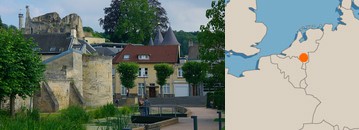

01. Data about the language
Language group
Indo-European / Germanic
Area
Limburgish is spoken in the two provinces of Limburg (Netherlands & Belgium), and in a few border villages in a small neighbouring part of Germany (the Selfkant area).
There are a lot of varieties of Limburgish. Each village and city has it's own dialect, but there is mutual understanding.
The dialects in the north of Dutch Limburg are not considered Limburgish. The north boundary of the language is roughly marked with the "ik-ich isoglosse". In this area, a lot of linguistic boundaries coincide. In the east, there is a fluent transition to the Rheinlandic dialects (Kerkrade-Aachen, Sittard- Selfkant, Venlo-Krefeld).
Updated, sourced data, checked on 14 October 2026 · scope : Pays-Bas (Limbourg) ; aire globale Pays-Bas, Belgique, Allemagne
Numerical strength
According to the Limburgse Academie, cited by the Mercator research centre, Limburgish has 1.2 to 1.5 million speakers in the Netherlands, Belgium and Germany1.
According to a 2021 survey of adults in Dutch Limburg, 78% can speak a variety of Limburgish, 67% of them "very well"; the share of fluent speakers ranges from 52% among 18–34 year-olds to 74% among those over 651. In 2019 Limburgish was the home language of 47.9% of the province's residents, against 46% for Dutch1.
Status
Limburgish has been recognised under Part II of the European Charter since 1997; in 2019 a covenant with the Dutch government recognised it as an "essential, fully-fledged and independent regional language"1. In December 2024 the province adopted the plan "Same veur 't Limburgs 2025–2027", preparing for recognition under Part III1.
Education
Since 1998 a regional language may be a medium of instruction alongside Dutch1. According to a 2022 survey in early-childhood settings, 68% of staff speak Limburgish with children; a bilingual pilot was launched in November 2023 and nine groups were taking part in early 20251. The province spends €1.1 million a year on the language, including €200,000 for early childhood, schools and education1.
Miscellaneous
The expertise centre Hoes veur 't Limburgs, the Veldeke Limburg association and the Limburgse Academie work to promote the language1.
Sources
- Limburgish in the Netherlands (Mercator Wiki), Mercator European Research Centre on Multilingualism and Language Learning (Fryske Akademy), mis à jour en 2026.
02. Linguistic description
Introduction in Limburgisch grammar
Information provided by Mathieu van Woerkom
The pronoun - 't pronoom
| (I) | ich | mien | mich |
|---|---|---|---|
| (you) | doe, dich, de, te* | dien | dich |
| (he) | hae, ‘r | zien | häöm |
| (she) | zie, 't, het** | häör | ze, häör, häöm** |
| (it) | 't, het | zien | 't, het |
| (we) | veer | oos | ós |
|---|---|---|---|
| (you) | geer, deer | eur | uch |
| (they) | zie | hun | ze |
| (you) | geer, g'r, deer, d'r*** | eur | uch |
|---|
The indicative pronoun - 't aanwiezend pronoom
| masculine | feminine | neuter | plural |
|---|---|---|---|
| (that) | (that) | (that) | (those) |
| dae | die | dat | die |
| daen, dem* | die | dat | die |
The indefinite article - 't ónbesjtömp artikkel
| masculine | feminine | neuter | plural |
|---|---|---|---|
| eine ('ne) | ein ('n) | ei (e) | gein |
| eine man (a man) | ein vrouw (a woman) | ei kèndj (a child) | gein kènjer (no children) |
The verbs - de verbe
| to be | to have | to be(come) | to go | to do | to see | to come | |
|---|---|---|---|---|---|---|---|
| infinitive | zeen | höbbe | waere | gaon | doon | zeen | kómme |
| I - ich | bin | höb | waer | gaon | doon | zeen | Kóm |
| you - doe | bis | höbs | waers | geis | deis | zuus | Kumps |
| he - hae | is | haet | weurt | geit | deit | zuut | Kump |
| we - veer | zeen | höbbe | waere | gaon | doon | zeen | Kómme |
| you - geer | zeet | höbt | waert | geit | deit | zuut | Kump |
| she-zie | zeen | höbbe | waere | gaon | doon | zeen | Kómme |
| past tense | |||||||
| I - ich | waor | hauw | woor | góng | deeg | zoog | Kaom |
| you - doe | waors | hauws | woors | góngs | deegs | zoogs | Kaoms |
| he - hae | waor | hauw | woort | góng | deeg | zoog | Kaom |
| we - veer | waore | hauwe | wore | gónge | dege | zoge | Kaome |
| you - geer | waor | hauw | woort | góng | deeg | zoog | Kaom |
| she-zie | waore | hauwe | wore | gónge | dege | zoge | Kaome |
| participle | gewaes | gehad | gewore | gegan | gegedaon | gezeen | gekómme |
| commanding | bis! | höb! | waer! | gank! | doog! | zuug! | kóm! |
The plural - Miervoud
In Limburgisch the plural can be formed in many different ways:
| singular | plural | |
|---|---|---|
| 1. singular + e | verbaod | verbaode (prohibitions) |
| 2. singular + s | gemeinde | gemeindes (communities) |
| 3. singular + er | hoes | hoezer (houses) |
| 4. singular + umlaut (change of vowel) | book | beuk (books) |
| waord | wäörd (words) | |
| voegel | vugel (birds) | |
| moes | muus (mice) | |
| vos | vös (foxes) | |
| boum | buim (trees) | |
| aap | aep (apes) | |
| man | men (men) | |
| 5. in some cases the plural is the same as singular | daag | daag (days) |
| sjoon | sjoon (shoes) |
The diminutive - 't dimmenetief
In Limburgisch, the diminutive is almost always formed with umlaut (change of vowel) + '-ke':
| word | diminutive | |
|---|---|---|
| wouf | wuifke (wolf) | |
| gaus | geiske (goose) | |
| draak | draekske (dragon) | |
| hoes | huuske (house) | |
| kook | keukske (cookie) | |
| aol | äölke (eel) | |
| Somtimes though, '-ke' is replaced by '-je' (because of the pronounciation): | zaod | zäödje (word) |
| paad | paedje (path) | |
| kèndj | kindje (child) | |
| land | lendje (land) | |
| In some cases an umlaut is not necessary: | Belsj | Belsjke (Belgje) |
| zits | zitske (zitvlakje van een stoel) |
03. Cartoon
No cartoon in this language could be found on public video platforms.