
Languages · Romance languages
Judeo-Spanish

01. Data about the language
Language group
Indo-European / Romance
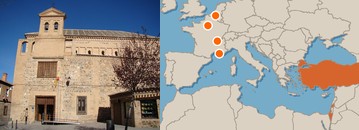
Area
Originally spoken in the former Ottoman Empire and in the north of Morocco, it is nowadays spoken in all those European and American countries to which Judeo- Spaniards have emigrated since 1870.
Judeo-Spanish results from the contact of several linguistic varieties of Spain, with a predominantly Castilian basis though, which the Jews of Spain took with them after Ferdinand of Aragon and Isabel of Castile decreed their eviction in 1492.
Through its two distinct varieties (calque and the vernacular), Judeo-Spanish today perpetuates linguistic features of pre-1492 Spanish and as such is precious to both philologists and social scientists. According to Michael Molho, in Literatura sefardita de Oriente, more than 5000 books and 300 newspapers have been written in that language and there are still many more to discover…
Updated, sourced data, checked on 14 October 2026 · scope : France et diaspora (Turquie, Israël, Europe, Amériques)
Numerical strength
According to INALCO, Judeo-Spanish (Ladino), the language of the Jews expelled from Spain in 1492, is now an endangered language; it is still spoken and written in Turkey, Israel and diaspora communities, notably in Paris, Lyon, Marseille, Brussels, Montreal, Miami, Mexico City and Buenos Aires1. This source gives no recent figure for the number of speakers1.
Status
In Israel, a National Authority for Ladino was created in 1998 to bring together efforts to defend and promote Judeo-Spanish language and culture1.
Education
INALCO in Paris has taught Judeo-Spanish since 1967 within its Hebrew and Jewish Studies department; it describes this programme as the only comprehensive teaching of the language in Europe1. Three levels are offered, also by distance learning with CNED, along with three bilingual certificates (Judeo-Spanish/Hebrew, Judeo-Spanish/Turkish, Judeo-Spanish/Modern Greek)1. A full programme also exists at three Israeli universities1.
Sources
- Judeo-Spanish (page de présentation de la langue et de son enseignement), INALCO – Institut national des langues et civilisations orientales, consulté en 2026.
02. Poem
03. Linguistic description
According to the linguist B. Pottier, when the Jews were expelled from Spain if 1492, they took with them the varieties of Spanish -Leonese, Aragonese and especially Castillan (the language of the Court) - that were common to those who practised the country's three religions. These form the substratum of that which, around 1620, would become the Judeo-Spanish vernacular, known as Spaniol, Judezmo, Judyô, Jidyô (according to Edgard Morin), Spaniolith (Spaniolish for the Nobel Prize winner Elias Canetti)or Espanioliko in the Middle East, Haketiya in northern Morocco or Tetuani in the region around Oran in Algeria. All of these terms designate the Judeo-Spanish vernacular, which would in turn also evolve. We say around 1620, because the process by which travellers from Spain stopped being able to understand the ancestor of their language in the Spanish spoken by the descendants of these they had expelled was a gradual one and attributed Jewishness to these people. Similarly, the Muslim Turks who knew Spanish only via the Jewish minority called the language Yahudije (Yahudice means 'Jewish' in Turkish). Thus, by means of a historical mistranslation, the Spanish Jews' language became their identifier. Judyô (Jew) designates both the language (the Judeo-Spanish vernacular) and the speaker of Judeo-Spanish (the Sepharad), as is the case with Yiddish (German Jüdïsch meaning 'Jew') for the Ashkenazim. By means of a similar mistranslation, we would have probably attributed a Judeo-French language to the French Canadians if they had been Jews! This is absurd, and yet the name Judeo-Spanish has stuck.
Judeo-Spanish, a language of fusion, is essentially 15th century Castillan, coloured initially by regionalisms and Hispanic Arabicisms, and after 1492 by Moroccan Arabicisms, Turkisms, ltalianisms, Hellenisms, Slavisms, etc. taken on in the various host countries. Later, with the creation of the schools of the Alliance Israélite Universelle in 1860, the language was affected by a mania for gallicisation, to the point that a new dialect called Judeo-fragnol (Judeo-Franco-Spanish) emerged.
Judeo-Spanish is a living museum for l5th century Spanish, indeed, in 1492 -the date of the Jews' expulsion from Spain- Castillan had not yet undergone the silencing of voice sibilants or the birth of the jota. Thus, the intervocalic z of that time remains, and one continued to say meza for mesa, (with s, 'table'). Similarly, one continued to say ka's'a for caja, 'box' or 'crate' or pa'z'a for paja, 'straw'. It is precisely for this reason that Don Quixote (Don Ki's'ote), which is now written Don Quijote -with jota- arrived in France as Don Quichotte, with (ch), reflecting the pronunciation of that time.
The distinction between b and v would also be maintained: kantava for cantaba, 'I' or 'he sang'. Other archaic forms also persisted: kavdal - kovdisya - kovdo -sivda(d) etc., which later became caudal in Spanish, 'goods on fortune', codicia 'cupidity or covetousness', code 'elbow', ciudad 'city', etc.
There are also numerous "vulgarisms" from that time: agora - prove - güeve - güerfano, etc. for ahora 'now' - pobre 'poor' - huevo 'egg' - huérfano 'orphan'. Similarly, the two forms muevo/nuevo coexist for "new".
Morphology: The old verbal forms do, vo, so and esto for doy 'I give', voy 'I go', soy 'I am' and estoy both 'I am' in English, continued to be used. As in the popular Spanish language, the second person form of the simple past already had a tendency to take on a final -s. The metathesis dl > ld of the imperative form also continued to be used : kantadlo > kantaldo 'sing it'.
These observations obviously provide only a few examples of illustrating a much broader topic.
In its subsequent evolution, Judeo-Spanish would develop particularly interesting strategies for hispanizing various loan of words. Thus, there is continuous use of the frequentative verbal ending -ear, as a verbal hispanizer for all loan of words from the Turkish, Arab, Bulgarian, Greek, etc host countries (adstrates), except for those of French origin, which take the -ar ending. Thus, from the Turkish dayanmak, 'resist, endure' we get the Judeo-Spanish form dayanear. In contrast, based on French "s'amuser" (to enjoy oneself), we have the form amüzarse. On the other hand, the ending -dero, which is very frequent in Spanish, is maintained but is used especially in forming words for obsessions or habits. We see this, for example, in the word arraskadero, whose meaning shifted from 'pruritus, itching' to 'obsession with scratching'.
Vocabulary and semantics (Spanish archaic usages): here are many examples: merkar 'to buy', trokar 'to change', mansevez 'youth', etc. The feminine gender of some nouns ending in -or is also kept, while these have become masculine in standard Spanish.
But along with these archaic usages, which are very understandable given the historical path of the language, there are also some genuine lexical creations based on Ladino (Judeo-Spanish calque), produced by the word-for-word translation from Hebrew into Spanish, which go back to the l3th or even the l2th centuries. All of these terms that are more archaic than the vernacular language are, via the intermediary of Ladino, a faithful reflection of the sacred languages (Hebrew and Aramaic), which makes them semi-sacred. By way of example, akunyadar/ear, which means "to fulfil the Levitical law." (i.e. the obligation found in the law of Moses for the brother of a dead man to marry the dead man's childless widow).
So, we con see that Judeo-Spanish is a language of fusion. Four percent of its loan words come from Hebrew, 15 percent from Turkish, 20 percent from French, two percent from Ladino, etc., with all of these built on the foundation of the 151h century Spanish substratum.
04. Cartoon
No cartoon in this language could be found on public video platforms.