
01. Data about the language
Language group
Indo-European / Celtic
Area
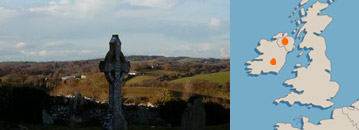
Irish is spoken by a number of families and communities scattered throughout the six counties of Northern Ireland.
The arrival of Celtic population in Ireland goes back to the III or IVth century BC. At the time of christianisation (Vth AC) Irish was spoken by most people.
The anglo-normand invasions of the XII and XIIIth century brought English as a language in Ireland. Irish culture and the language liveliness persisted in spite of official prohibitions (the law of 1537 was the strongest prohibition of the language). Irish literature goes back to the VIIth century and is therefore one of the eldest written language in Europe.
Updated, sourced data, checked on 14 October 2026 · scope : Irlande ; Royaume-Uni (Irlande du Nord)
Numerical strength
Ireland, 2022 Census: almost 1.9 million people aged 3 and over (about 40%) said they could speak Irish, 112,500 more than in 20161. Of these, 195,029 said they spoke it very well, 593,898 well and 1,034,132 not well1. Nearly 72,000 people speak it daily outside the education system (about 1,900 fewer than in 2016) and just over 115,000 weekly1. In the Gaeltacht, just over 20,000 people speak it daily, 31% of Irish speakers there1.
Northern Ireland, 2021 Census: 228,617 people aged 3 and over (12.4%) have some ability in Irish; 126,743 (6.9%) can speak it, of whom 43,557 speak it daily2.
Status
European Union: Irish, an official and working language of the EU since 2007 under a derogation limiting translation, gained full status on 1 January 2022, when that derogation ended3.
Ireland: the Official Languages (Amendment) Act 2021, enacted on 22 December 2021, replaces public bodies' language schemes with language standards and sets the objective that 20% of new recruits to the public service be proficient in Irish by 20304.
Northern Ireland: the Identity and Language (Northern Ireland) Act 2022 contains provisions on the Irish language and creates an Irish Language Commissioner5.
Public services
Ireland: under the 2021 Act, public bodies must place at least 20% of their annual advertising in Irish, use logos in Irish or in both languages, provide application forms in Irish and reply on social media in the language used; a deadline is to be set for all State services in the Gaeltacht to be available in Irish4.
Education
Sources
- Census 2022 Results Profile 8 – The Irish Language and Education (communiqué), Central Statistics Office (CSO), 2023.
- Census 2021 main statistics language tables : MS-B05 Knowledge of Irish ; MS-B07 Frequency of speaking Irish, Northern Ireland Statistics and Research Agency (NISRA), 2022.
- Irish gains full status as an official language of the EU, Centre de traduction des organes de l'Union européenne (CdT), 2022.
- Official Languages (Amendment) Act 2021, An Coimisinéir Teanga, consulté en 2026.
- Identity and Language (Northern Ireland) Act 2022 – table des matières, legislation.gov.uk, 2022.
- Irish Medium Education 2025/26 (Northern Ireland School Census), Department of Education (Northern Ireland), 2026.
- TG4 celebrates outstanding year of viewership and engagement in 2024, TG4, 2025.
02. Poem
03. Linguistic description
Irish is a Celtic language of the Goidelic branch2. Sentences begin with the verb, followed by the subject and then the object1. It has no indefinite article, and its pronouns make no politeness distinction1.
Sources
The 2003 CD had no description of this language: this text was written for the site from the sources below.
- WALS Online – Irish, World Atlas of Language Structures, Max Planck Institute for Evolutionary Anthropology, 2013 (v2026).
- Glottolog 5.3 – Irish, Max Planck Institute for Evolutionary Anthropology, 2025.
04. Cartoon
Video hosted on YouTube and published by the channel shown; its author may remove it at any time.