
01. Data about the language
Language group
Indo-European / Greek
Area
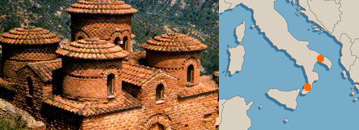
Greek is spoken in the regions of Puglia and Calabria.
There are two hypotheses about Greeks presence in Italy. Some say that the settlement goes back to Magna Graecia, classic period, antiquity. Some others believe that there is no link with antiquity for this presence, but on the contrary that the settlement goes back to Byzantine era.
Wherever and whenever they might be coming from, the decline of the Byzantine empire lead to a crisis for the Greek speaking persons of Italy, and they finally used some italo- romance as a lingua franca. The written version of “grico” brought several problems, and finally local intellectuals opted for writing with Latin characters.
.
Updated, sourced data, checked on 14 October 2026 · scope : Italie (Grecìa Salentina dans les Pouilles ; Calabre)
Numerical strength
Grecìa Salentina (Apulia): in 2015, out of about 41,500 inhabitants, some 20,500 were estimated to speak Griko, mostly older people; the language is no longer spoken in Melpignano or Soleto1. The Mercator research centre classifies Griko as severely endangered1. It gives no figure for the Grecanico (Greko) of Calabria, mutually intelligible with Griko but separately developed1.
Status
Italian Law 482/1999 (Article 2) recognises the Griko community as a Greek ethnic and linguistic minority, alongside eleven other languages1. Italy signed the European Charter for Regional or Minority Languages in 2000 without ratifying it; it has, however, ratified the Framework Convention for the Protection of National Minorities1.
Education
In Salento, Griko is taught as a subject from nursery to secondary school, usually one hour a week, focusing on poetry, folklore, dance and traditions1. The Ministry of Education's "Griko Project" introduced it in nursery, primary and lower-secondary schools of the municipalities concerned; the "Pos Màtome Griko" programme (2011) follows CEFR levels A1 to B21. Modern Greek has been taught systematically there since 1994, with teachers sent by the Greek Ministry of Education1.
Media
The "Griko Project" supported radio broadcasts in Griko and the distribution of periodicals in the language; poems and texts in Griko appear in the local press for patron saints' days1.
Miscellaneous
The Union of the Municipalities of Grecìa Salentina, founded in 1966, promotes the language through university research, teaching and the publication of books and poetry in Griko1.
Sources
- Griko in Italy (Mercator Wiki), Mercator European Research Centre on Multilingualism and Language Learning (Fryske Akademy), mis à jour en 2026.
02. Linguistic description
Modern Greek has three genders and three cases1. Word order is flexible: no order is dominant1. It calls tea τσάι (tsái), from Chinese cha, like the languages that received tea overland1,2.
Sources
The 2003 CD had no description of this language: this text was written for the site from the sources below.
- WALS Online – Greek (Modern), World Atlas of Language Structures, Max Planck Institute for Evolutionary Anthropology, 2013 (v2026).
- Ö. Dahl, « Tea », chapitre 138 du WALS, World Atlas of Language Structures, Max Planck Institute for Evolutionary Anthropology, 2013.
03. Cartoon
Video hosted on YouTube and published by the channel shown; its author may remove it at any time.