
01. Data about the language
Language group
Indo-European / Romance
Area
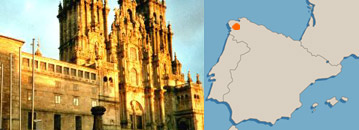
Galician is spoken in the autonomous community of Galicia (provinces of Coruna, Lugo, Ourense and Pontevedra), as well as in the Asturias/Galicia and Castilla-Leon/Galicia border regions.
Galician is a Romance language which grew up around the 9th Century as an off-shoot of the Vulgar Latin brought to the Iberian Peninsula by the Roman legions during the period of Romanisation. Afterwards, Galician, spread out southwards and up to the XIIth century the literature was extremely rich and diversified. Up to that time, Galician was spoken by the whole society, among the administration and the Courts. When the Portuguese and Spanish kingdoms split in 1668, the galego-portuguese language became the normalised, codified language of Portugal, while –on the Spanish side- it remained the most frequent oral communication mean. The XIXth was a period of revival for Galician with a noticeable increase in the literature production and other cultural developments. This was also a period for controversy : should the language be normalised according with Portuguese’s rules, or according to some Galician's proper rules (to be created). Every body agreed that the basic structures were similar, and linguistic normalization started at the beginning of the XXth century, continued during Franco’s era, and climaxed with the normalization law of 1983
Updated, sourced data, checked on 14 October 2026 · scope : Espagne (Galice)
Numerical strength
According to the 2023 survey of the Galician Institute of Statistics (IGE), analysed by the Real Academia Galega, for the first time Galician is no longer the habitual language of the majority: 52.94% of Galicians aged 5 and over habitually speak Castilian1. Over twenty years, the number of Galician speakers (monolingual or bilingual) fell by 400,000, while Castilian speakers increased by 380,0001.
First language: 34% of the population learned to speak in Galician, 33% in Castilian and 29% in both; Castilian is the majority first language among under-50s1.
Young people: among 5–14 year-olds, those who always or mostly speak Galician now account for only 16%, about 34,000 children, against some 180,000 for Castilian1. Among those aged 15 and over, a majority, though shrinking, say they can speak Galician, but only half rate this ability as satisfactory, and 40% say they cannot write it1.
Status
Galician Law 3/1983 on linguistic normalisation states that "Galician is the language proper to Galicia" and that it is an official language of the institutions of the Autonomous Community, its administration and local authorities, Castilian also being official as the language of the State2. The duty to know Galician contained in this law was declared unconstitutional by the Constitutional Court in 1986 (ruling 84/1986)2.
Public services
Citizens have the right to use Galician, orally and in writing, in their dealings with the public administration in Galicia2.
Education
Decree 79/2010 on plurilingualism in non-university education requires subjects taught in Galician and in Castilian to be split equally in weekly hours3. In primary school, environmental studies are taught in Galician and mathematics in Castilian; in lower secondary (ESO), social sciences, geography and history and natural sciences are taught in Galician, and mathematics, technology and physics and chemistry in Castilian3. Non-language subjects may be taught in a foreign language, mainly English, for up to a third of weekly hours3.
Media
Law 9/2011 on Galician public audiovisual media, which made Galician the language of the Corporación RTVG, was repealed on 7 April 2025 by Law 1/20255. The statutes of the new Corporación de Servizos Audiovisuais de Galicia, published in August 2025, provide that the public media produce their programmes, content and services in Galician, the company's language of "habitual and preferred use"4.
Sources
- Informe sobre a situación da lingua galega segundo os datos do Instituto Galego de Estatística de 2023 (H. Monteagudo, X. Loredo, G. S. Vázquez-Grandío), Real Academia Galega, Seminario de Sociolingüística, 2024.
- Ley 3/1983, de 15 de junio, de normalización lingüística (texto consolidado), Boletín Oficial del Estado, 1986.
- Decreto 79/2010, do 20 de maio, para o plurilingüismo no ensino non universitario de Galicia (DOG n° 97, 25/05/2010), Xunta de Galicia, Diario Oficial de Galicia, 2010.
- Resolución de 31 de julio de 2025 por la que se ordena la publicación de los estatutos de la Corporación de Servizos Audiovisuais de Galicia, S.A. (DOG n° 157, 19/08/2025), Xunta de Galicia, Diario Oficial de Galicia, 2025.
- Ley 9/2011, de 9 de noviembre, de los medios públicos de comunicación audiovisual de Galicia (abrogée le 7 avril 2025 par la Ley 1/2025), Boletín Oficial del Estado, 2025.
02. Poem
03. Linguistic description
Galician, defined in the Autonomous Statutes as Galicia’s own natural language, is a Romance language which grew up around the 9th Century as an off-shoot of the Vulgar Latin brought to the Iberian Peninsula by the Roman legions during the period of Romanisation. This language eventually took over from the many Pre- Celtic, Celtic and Para- Celtic languages spoken around the north-west of the Peninsula which, owing to their number and to the fact that they were purely oral languages, were unable to withstand the pressure of the more highly developed, written Latin, and only survived as a substratum affecting the vocabulary and the pronunciation of the latter. Languages spoken by other peoples including the Germanic Swabians and the Visigoths and also, albeit to a lesser extent, Arabic, influenced the way this Vulgar Latin was to evolve, eventually emerging as a fully-fledged Romance language in its own right known as galego (‘Galician’), which owes its name to the Roman Province of Gallaecia which once stretched far beyond the limits of modern-day Galicia into what is now Portugal, the birthplace of what went on to become an independent kingdom. Portugal was, therefore, a ‘Gallaician’ kingdom where Galician was spoken. However, following the split of Galicia and Portugal, which expanded southwards to the Algarve, the language spoken there came to be known as ‘Portuguese’, the name by which it was to continue to be known around the globe when Portugal became a colonial power. From the historical point of view, both Galician and Portuguese are, therefore, one and the same language. However, the political division of Galicia and Portugal which first began in the 11th Century, coupled with the subsequent domination of Galicia by the Kingdom of Castile meant that the natural differences in the way the language was spoken on either side of the River Minho, which over the centuries had come to be a political frontier, grew ever wider.
The history of the Galician language can be divided into three main periods: Old, Middle and Modern Galician. Old Galician, also known as Medieval Galego-Portuguese, covers the period from the appearance of the language in the Middle Ages to the 15th Century. For over seven hundred years, Galician was a completely normal language used by all sectors of society, although, as in the rest of the Roman Empire, in the early years Latin still held sway as the language of writing. In the latter part of this same period, Castilian Spanish also started to make inroads as the language of the ruling classes imposed on Galicia from outside. During this period, the Galician language (better referred to as Galego-Portuguese) reached great heights of literary fame, particularly as a language of poetry, giving rise to the brilliant school of Galego-Portuguese poetry with such rich and varied writings as the renowned Cantigas de Amor, the Cantigas de Amigo and the Cantigas de Escarnio e Maldizer amongst others.
Middle Galician covers the period C. XVI-XVIII, known as the ‘Dark Years’ owing to the almost complete disappearance of Galician as a written language. The political colonisation of Galicia by the Kingdom of Castile which first set in towards the end of the previous period was accompanied by the gradual imposition of Castilian Spanish as the language of power and administration, thereby making it the official language to all extents and purposes. Galician, which was still spoken by the whole of the population, found itself relegated to the rank of a purely spoken language, increasingly eschewed by the ruling classes and coming to be seen as an inferior language spoken by uneducated and ignorant people. Along with the loss of prestige and the scorn suffered by the language itself, Galician literature which had seen such a heyday in years gone by, also soon all but disappeared.
Modern Galician covers the period C. XIX-XX. Although the 19th Century witnessed a literary Revival with such outstanding writers as Rosalía de Castro, on the political and social fronts Galician continued to play a secondary role to Castilian Spanish which was the language of administration, teaching, the Church, etc., effectively making it the language of power and the only official language. On the other hand, this period also saw the birth of a burgeoning Galician political and cultural movement which advocated the use and a renewed dignity for the Galician language. During the first third of the 20th Century, Galician continued to win back ground as a means of literary expression, spurred on by the emergence of Galician nationalism which made the language one of the mainstays of its political agenda. However, the Spanish Civil War which broke out in 1936, followed by Franco’s dictatorship, brought the all of these efforts in favour of Galician to an abrupt halt. After the death of Franco in 1975, work began to set in motion a process of legal changes which led to the recognition of Galician as one of the two official languages of Galicia alongside Spanish. The Law of Language Normalisation was also issued, effectively bringing the Galician language into the education system and into public administration, although many of the goals set out in this Law still remain to be fulfilled.
Apart from the fact that Galician is spoken around the globe in the form of Portuguese, a language with which it still has a great deal in common despite the differences which mainly affect pronunciation, Galician per se is spoken today in the four Provinces which make up the Autonomous Community of Galicia, i.e. A Coruña, Lugo, Ourense and Pontevedra, as well as in the areas bordering Asturias, Leon and Zamora. It is also kept alive throughout the world by the many Galician émigrés living abroad. Although recent years have been marked by an alarming drop in the number of younger speakers, coupled with the fact that the diglossic situation with regards to Spanish has yet to be fully overcome, Galician continues to be spoken by the vast majority of the population and over 80% can speak the language and practically all of the population can understand it.
X. R. Freixeiro Mato
04. Cartoon
Video hosted on YouTube and published by the channel shown; its author may remove it at any time.