
01. Data about the language
Language group
Indo-European / Germanic
Area
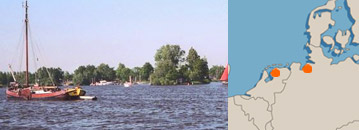
West Frisian is spoken in the province of Fryslan/Friesland (Netherlands), and in a few border villages in the neighbouring province of Groningen.
There are three main varieties of Frisian: West Frisian (Frysk) which is spoken in the province of Fryslân/Friesland in the Netherlands, North Frisian (Friisk) which is spoken in Schleswig-Holstein (Germany) and East Frisian or Saterlandic (Seeltersk) which is spoken in Niedersachsen (Germany).
Updated, sourced data, checked on 14 October 2026 · scope : Pays-Bas (Fryslân) ; Allemagne (frison du Nord en Schleswig-Holstein, frison du Saterland en Basse-Saxe)
Numerical strength
Status
The 2014 Act on the Use of the Frisian Language (Wet gebruik Friese taal) makes Frisian and Dutch the official languages of the province of Fryslân1. An administrative agreement between the State and the province (BFTK), renewed every four years, covers 2024–20281. The Netherlands has ratified Part III provisions of the European Charter for Frisian in pre-school, primary, secondary, higher and adult education, but not in vocational education1.
Germany: North Frisian (Schleswig-Holstein) and Saterland Frisian (Lower Saxony) are protected under the European Charter; since 2022 the Federation has contributed €50,000 to fund the post of scientific officer for the Saterland Frisian language2.
Public services
Frisian may be used in dealings with the province's administrative and judicial authorities1.
Education
Frisian has been compulsory in primary school since 1980 and in the first two years of secondary school since 19931. In 2018 only 27.4% of primary schools (113 of 412) and 39.4% of secondary schools (28 of 71) met all attainment targets; in 2019 the Inspectorate found that 34.9% of primary and 22% of secondary teachers lacked a Frisian qualification1. A network of trilingual schools (Frisian, Dutch, English) exists in primary and secondary education1.
Germany: in 2025–26, Frisian is taught in 10 schools in Schleswig-Holstein, two of them Danish-minority schools, to 740 pupils2.
Media
Omrop Fryslân is the regional public broadcaster in Frisian (news, radio, television, educational programmes)1.
Sources
- Frisian in the Netherlands (Mercator Wiki), Mercator European Research Centre on Multilingualism and Language Learning (Fryske Akademy), mis à jour en 2026.
- Achter Bericht der Bundesrepublik Deutschland gemäß Artikel 15 Absatz 1 der Europäischen Charta der Regional- oder Minderheitensprachen (Drucksache 21/6400), Deutscher Bundestag / Bundesregierung (Bundesministerium des Innern), 2026.
02. Poem
03. Linguistic description
Along the Dutch and German coasts of the North Sea, a small community of about 600.000 people speak a language that is different from Dutch or German. It is a West-Germanic language, somewhere between German and Dutch on the one hand and English on the other hand. More specifically, Frisian belongs to the North Sea Germanic dialects (like English and Frisian), the so-called Ingveon. As to the way it sounds, and -to a lesser extent- as to the vocabulary Frisian is similar to (old) English. To compare:
| ENGLISH | FRISIAN | DUTCH | GERMAN |
|---|---|---|---|
| Us | Ús | Ons | Uns |
| Cheese | Tsiis | Kaas | Käse |
| Key | Kaai | Sleutel | Schlüssel |
| Have been | Ha west | Ben geweest | Bin gewesen |
| Two sheep | Twa skiep | Twee schapen | Zwei Schafe |
Although Frisian is not a North Germanic dialect, there is some relationship with the Scandinavian languages as well. The Frisian word for "child", "bern" (pronounce "ben") derives from the equivalent of the English verb "to bear" and the old Dutch word "boreling". In Scandinavia the word still exists as "barn" or "børn".
Old Frisian, very close to Anglo-Saxon, was spoken all over the Low Countries' coastal provinces and in German Ost- and Nordfriesland, up to the Danish border. The Anglo-Saxon bishop Boniface was understood that well in 754 AD, that he was killed in Frisia. From the 16th Century onwards, Frisian was gradually replaced by Dutch in the administration, the judiciary, school and church. The age of Romanticism (19th Century) did a great deal for the revival of Frisian language awareness. Only after World War II, the Frisian language regained an official status in all domains of life.
04. Cartoon
Video hosted on YouTube and published by the channel shown; its author may remove it at any time.