

01. Data about the language
Language group
Indo-European / Germanic
Area
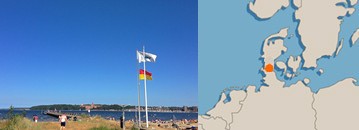
Danish is spoken in Schleswig, mainly in the rural districts of Rendsburg/Eckernförde, Schleswig/Flensburg, Nordfriesland and the city of Flensburg.
The Duchy of Schleswig have belonged to the Danish territory for a long time ; since the Lutheran Reform, German has progressively been introduced. Claimed both by Germany and Denmark, the Schleswig-Holstein became part of Prussia in 1864 and from this date, we can speak about a Danish minority in Germany.
Updated, sourced data, checked on 14 October 2026 · scope : Allemagne (Schleswig-Holstein)
Status
The protection and promotion of national minorities, including the Danish minority, is enshrined in the constitution of the Land of Schleswig-Holstein, and the European Charter for Regional or Minority Languages is an important basis for it1. Since 1988 a commissioner of the Minister-President for minority affairs has been the contact person for the Danish minority1.
Education
The Danish School Association for South Schleswig (Dansk Skoleforening for Sydslesvig) ran 54 institutions on 16 June 2025; in 2025–26, 5,903 pupils attend the 39 schools of the Danish minority1. In public schools, Danish is taught in 2025–26 at 69 schools to 4,946 pupils; ten primary schools (13 sites) offer optional Danish lessons under a pilot project launched in 2020–21 with seven schools1.
Sources
- Achter Bericht der Bundesrepublik Deutschland gemäß Artikel 15 Absatz 1 der Europäischen Charta der Regional- oder Minderheitensprachen (Drucksache 21/6400), chapitre 4.1 « Dänisch in Schleswig-Holstein », Deutscher Bundestag / Bundesregierung (Bundesministerium des Innern), 2026.
02. Poem
03. Linguistic description
Danish is a Germanic language belonging to the Scandinavian sub-group. It is a language linguistically very close to Swedish and the two Norwegian languages (Nynorsk and Bokmaal). It is spoken in Denmark, but it also enjoys a co-official status in two other countries under the Crown of Denmark's rule: the Faeroes Islands and Greenland.
Its linguistic kinship with other languages of the Germanic group is high:
| Danish | English | German | French |
|---|---|---|---|
| Brød (pronounced 'breul') | Bread | Brot | Pain |
| Kirke | Church | Kirche | Eglise |
| Jeg kan (pronounced 'yay kan') | I can | Ich kann | Je peux |
| Dag (pronounced 'day') | Day | Tag | Jour |
Two things are striking when one first hears Danish:
The soft "d". This odd characterisation relates to a surprising phoneme, half way between French "l" and English "th". It turns to be hard to pronounce for a non-Dane.
The « stød » . This consists of a sort of "glottal stop" similar to the one that exists in Arabic. It is characteristic of the Danish varieties spoken in Copenhagen and Sjaelland in particular, and consists in a kind of break between syllables that is reminiscent of the sound of a cough.
The variety of Danish spoken in the Schleswig is broadly speaking identical to standard Danish, but the accent of this region that shares borders with Jutland is very peculiar and German-influenced. On both sides of the border, one finds some kind of mixed dialect, southern Jutlandish, which is also called sønderjysk.
Danish owes its literary fame to major authors like Karen Blixen , whose novel 'A Farm in Africa' served as basis for the film 'Out of Africa', to philosopher Kirkegaard , whose name means 'the churchyard, the cemetery', or H.C Andersen , who wrote children tales (do not forget to mention his initials before referring to him as Andersen is one of the most common surnames in Denmark)
04. Cartoon
Video hosted on YouTube and published by the channel shown; its author may remove it at any time.