

01. Data about the language
Language group
Indo-European / Celtic
Area
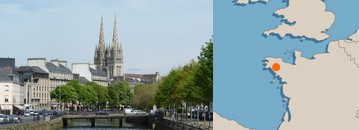
Breton is spoken mainly in its historical region in the west, which comprises all of Finistère and the western part of Côtes-d'Armor and Morbihan. Breton speakers are also found in the cities of Rennes and Nantes, and in Paris.
Breton belongs to the Brittonic branch of the Insular Celtic family. The Continental branch (Gaulish, Galatian, etc.) is nowadays extinct. As a Brittonic language, Breton is close to Welsh and Cornish. It is parent to Scottish Gaelic, Manx and Irish, but mutual understanding is not possible. Breton people came from Wales down to Brittany to settle, between the IIIrd and the VIth century (AD). Welsh and Breton became clearly separate languages from the XVIth century.
Updated, sourced data, checked on 14 October 2026 · scope : France (Bretagne historique : Région Bretagne et Loire-Atlantique)
Numerical strength
According to the latest survey commissioned by the Brittany Region, carried out in 2024, Breton has about 107,000 speakers1.
The Office public de la langue bretonne still displays the estimate based on the 2018 survey: 225,000 active and 125,000 passive speakers aged over 23. According to that 2018 survey, 78% of speakers were over 604.
Status
The Constitution states that "the language of the Republic is French" (Art. 2) and that "regional languages belong to the heritage of France" (Art. 75-1)8. France signed the European Charter for Regional or Minority Languages on 7 May 1999, but the Constitutional Council ruled that it contained clauses contrary to the Constitution11. Law no. 2021-641 of 21 May 2021 includes regional languages in the linguistic heritage protected by the Heritage Code9; the Constitutional Council struck down two of its articles, on immersion teaching and on diacritical signs in civil registers10.
Breton has no specific legal status; the OPLB describes it as the only Celtic language in that situation4. The State and the Brittany Region are bound by a "specific agreement for the transmission of the languages of Brittany and the development of their everyday use" for 2022–20271, whose main target is 30,000 bilingual pupils2. The Region adopted a language policy plan in 2004, updated in 2012 and again in 2024; the Finistère department adopted a language scheme in 2016, renewed in 20234.
Public services
The 2021 law allows public services to display translations into the regional language on public buildings, roads, transport infrastructure and their main communication materials9. However, the Constitutional Council held that a provision granting individuals a right to use a language other than French in their dealings with the administration was contrary to Article 2 of the Constitution10.
In Finistère, Morbihan and western Côtes-d'Armor, road direction signs are systematically bilingual; municipalities have also made town signs, street name plates, websites and other materials bilingual4. The Region's language action covers in particular TER regional trains, tourism and public buildings4.
Education
At the start of the 2025 school year, 19,978 pupils were enrolled in bilingual streams (11,152 in public schools, 5,126 in Catholic schools, 3,700 at Diwan), in 702 schools and 215 municipalities3. This is the first fall in enrolment (302 fewer pupils) in 48 years of bilingual education; only the public stream is growing5. In addition, 4,044 pupils in monolingual streams took Breton classes at secondary level (2025) and 7,382 primary pupils had an introduction to the language (2024); 857 university students took Breton courses, 198 of them on the Breton language degree3.
According to the Ministry of Education, the number of pupils receiving some form of Breton teaching rose from 15,351 in 2020 to 26,230 in 2023, in nearly 1,100 classes2.
Adults (2025): 17,379 learners on the Desketa platform, 3,130 in weekly classes and 357 on 3- or 6-month intensive courses3.
Media
Television: Breton programmes have been broadcast on France 3 for more than 40 years; the local channels Tébéo, TébéSud and TVR also carry them, as does the web TV Brezhoweb6.
Radio: the local France Bleu stations (now ICI) have broadcast Breton programmes since 1982; community radio stations pool their programmes through Brudañ ha Skignañ6.
Press: the monthly Bremañ has appeared since the early 1980s and the weekly Ya! since the mid-2000s6. Under the 2024–2027 Plan for the re-appropriation of the languages of Brittany, the Region asked the OPLB to create the Kleweled.bzh portal, which gathers Breton-language audiovisual content6.
Miscellaneous
Sources
- Dossier de presse « Mois du breton 2025 », Université de Bretagne occidentale (UBO), 2025.
- Question écrite n° 5721 « Application des engagements de l'État pour l'enseignement du breton » et réponse du ministère de l'Éducation nationale (JO du 16 décembre 2025, p. 10291), Assemblée nationale, 17e législature, 2025.
- Les chiffres clés de la langue bretonne, Office public de la langue bretonne (OPLB), consulté en 2026.
- Situation sociolinguistique, Office public de la langue bretonne (OPLB), consulté en 2026.
- L'enseignement bilingue en 2025, Office public de la langue bretonne (OPLB), Observatoire des pratiques linguistiques, 2025.
- Media, Office public de la langue bretonne (OPLB), consulté en 2026.
- Ya d'ar brezhoneg, Office public de la langue bretonne (OPLB), consulté en 2026.
- Constitution du 4 octobre 1958 (texte intégral en vigueur), Conseil constitutionnel, consulté en 2026.
- Loi n° 2021-641 du 21 mai 2021 relative à la protection patrimoniale des langues régionales et à leur promotion (texte publié au JO n° 119 du 23 mai 2021, reproduit dans le recueil des travaux préparatoires), Légifrance ; ministère de la Culture, 2021.
- Décision n° 2021-818 DC du 21 mai 2021, Conseil constitutionnel, 2021.
- Décision n° 99-412 DC du 15 juin 1999 — Charte européenne des langues régionales ou minoritaires, Conseil constitutionnel, 1999.
02. Poem
03. Linguistic description
Breton is nowadays spoken by about 300 000 people, within friends or family. But it is more and more common to hear again Breton in the street and its place in the public life grows up again.
Breton belongs to the Celtic family and is very close to Welsh and Cornish (Brittonic branch). Breton and Welsh sailors would understand each others without problems until the XVIth and Cornish remains very easy to understand for a Breton-speaker.
| Breton | Welsh | English |
|---|---|---|
| yezh | iaith | language |
| vi | wy | egg |
| dour | dwr | water |
It is also related to Irish and Scottish Gaelic (Goidelic branch), but only a few words are still common between the two branches :
| Breton | Irish | English |
|---|---|---|
| amann | im | butter |
| ti | tigh | house |
| mad | math | good |
It can sound rather exotic to non-Celtic language speakers; The melody, with its regular stress on the second last syllabus and the frequency of the sound, written as c'h (roughly pronounced as the Spanish jota or the ch in the German doch) make it easy to identify.
When learning Breton, the main difficulty, typical of the Celtic languages, is the phenomenon called mutation; The first consonant of a Breton word can change depending on the grammatical context in which it is used. For example :
| isolated word | word in another context |
|---|---|
| Gortoz (to wait) | c'hortoz (waiting) |
| Kemper (Quimper¹) | Da Gemper (to Quimper) |
| Tad (father²) | Ma zad (my father) |
Looking for a word in a Breton dictionary requires therefore to know the main mutation rules !
A few words in Breton
| Breton | English |
|---|---|
| Mont a ra ? | Hello ( Is it going ?) |
| Kenavo, d'ar wech all | Good bye, see you |
| Komz a rez brezhoneg, galleg, saozneg, svedeg ? | Do you speak Breton, French, English, Swedish ? |
| Pelec'h emañ an aodoù ? | Where is the beach ? |
| Pellgomz a c'hellit d'am zi-bank e Bro-Saoz ? | Could you phone my bank in England ? |
| Hañv e vez e Breizh pa vez tomm ar glav ! | It's summer in Brittany when the rain is warm ! |
| Ur c'harr-tan nevez eo ! Met me gav din ez eus un trouz iskis gant ar c'heflusker... | It's a new car, but I think there is strange noise in the engine... |
04. Cartoon
Video hosted on YouTube and published by the channel shown; its author may remove it at any time.