

01. Data about the language
Language group
Basque (Isolated)
Area
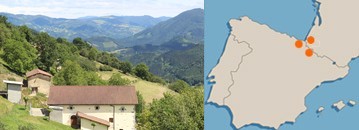
Basque is spoken in the western region of Pyrénées-Atlantiques in the historical provinces of Labourd, Bas-Navarre and Soule.
According to the linguists’ classifications, Basque has a special status among European languages. There seem to be no other related language. Over more, the language seems to be spoken on the territory where it had anciently been created. Basque has had strong links with the neighboring tribes (Iberians, Celtics, Gallics...), which arrived through successive waves of migration, but they have always kept a special commitment for their own linguistic and cultural patrimony. Basque literature was born during the XVIth century; the first book ever published in Basque language was published in 1545. The Kingdom of Navarre, existing since the IXth century, was incorporated to the kingdom of Castile in 1512. The lower Navarre, North to the Pyrenees, could survive some additional decades before being attached to France. Among the Spanish kingdom, Navarre kept some administrative and legal privileges.
Updated, sourced data, checked on 14 October 2026 · scope : France (Pays basque nord), Espagne (Communauté autonome basque, Navarre)
Numerical strength
According to the 7th Sociolinguistic Survey (2021), carried out jointly by the Basque Government, the Government of Navarre and the Office public de la langue basque, 30.2% of inhabitants aged 16 and over across the Basque-speaking territory are Basque speakers, i.e. 809,341 people, and 16.1% are passive bilinguals1.
Northern Basque Country (France): 20.1% Basque speakers (51,484 people) and 9.4% passive bilinguals; the figure was 26.4% in 19961. It reaches 47.5% in Lower Navarre and Soule, against 16.1% in Labourd1.
Spain: 36.2% Basque speakers in the Basque Autonomous Community (681,072 people, up from 24.1% in 1991) and 14.1% in Navarre (76,784 people, up from 9.5% in 1991)1. Among 16–24 year-olds the share is 74.5% in the Autonomous Community, 28% in Navarre and 21.5% in the Northern Basque Country1.
Use: in 2021, 17.5% of inhabitants aged 16 and over used Basque as much as or more than French or Spanish (22% in the Autonomous Community, 6.8% in Navarre, 7.1% in the Northern Basque Country)2.
Status
France: the Constitution states that "the language of the Republic is French" (Art. 2) and that "regional languages belong to the heritage of France" (Art. 75-1)8. France signed the European Charter for Regional or Minority Languages on 7 May 1999, but the Constitutional Council ruled that it contained clauses contrary to the Constitution11. Law no. 2021-641 of 21 May 2021 includes regional languages in the linguistic heritage protected by the Heritage Code9; the Constitutional Council struck down two of its articles, on immersion teaching and on diacritical signs in civil registers10.
Spain: in the Basque Autonomous Community, Law 10/1982 makes Basque "the language proper to the Basque Country" and grants everyone the right to use Basque as well as Castilian5. Law 5/2026 of 25 June 2026 regulates language-profile requirements in the Basque public service7. In Navarre, Foral Law 18/1986 (titled "del Euskera" since 2017) divides the territory into three zones; Basque is co-official with Castilian only in the Basque-speaking zone4,6. Foral Law 9/2017 moved 44 municipalities from the non-Basque-speaking zone to the mixed zone, and the municipality of Atetz from the mixed to the Basque-speaking zone4. Spain has ratified the European Charter; the instrument of ratification was published in the Boletín Oficial del Estado on 15 September 200112.
Public services
France: the 2021 law allows public services to display translations into the regional language on public buildings, roads, transport infrastructure and their main communication materials9. However, the Constitutional Council held that a provision granting individuals a right to use a language other than French in their dealings with the administration was contrary to Article 2 of the Constitution10.
Spain: in the Basque Autonomous Community, everyone has the right to address the administration in Basque or Castilian and to be served in the official language of their choice5. In Navarre, Foral Decree 103/2017 regulates the use of Basque by zone: either language may be used in the Basque-speaking zone, and citizens may address the administration in Basque in the mixed and non-Basque-speaking zones4. Several of its articles, notably on counting Basque as a merit in public employment and on bilingual signage, were annulled by the High Court of Justice of Navarre in 20194.
Education
Northern Basque Country: at the start of the 2023 school year, out of 51,763 pupils, 6,641 primary pupils were in bilingual education and 3,969 in immersion; at lower-secondary level, 2,341 pupils were in bilingual and 1,078 in immersion streams; at upper-secondary level, 625 and 4743. In 2023–2024, 47 public or Catholic private schools offered immersion teaching at nursery level, and the Seaska network opened its fifth secondary school, in Saint-Pée-sur-Nivelle3. The 2021 law provides that, under agreements between the State and the regions, the regional language is taught within normal school hours9.
Spain: in 2023–2024, 71% of non-university pupils in the Basque Autonomous Community were enrolled in model D (Basque-medium) and 16.4% in model B; in Navarre, 23.5% were in model D2. In 2022–2023, 54.3% of undergraduates at the University of the Basque Country (UPV/EHU) took at least one subject in Basque2.
Adults: 41,080 people were enrolled in Basque courses in 2023–2024 (34,208 in the Autonomous Community, 4,842 in Navarre, 2,030 in the Northern Basque Country)2.
Media
Northern Basque Country: five Basque-language media are grouped in the association Euskal Hedabideak; the TV channel Kanaldude has been carried by Bouygues, Free and SFR since 2023; the OPLB supports the network of Basque-language radio stations (Euskal Irratiak); 11,293 Fransat cards had been activated to receive the Basque public broadcaster ETB3. A university diploma in Basque-language journalism was launched in 20233.
Navarre: the Basque public channels ETB1 and ETB3 are received, seven radio stations broadcast entirely in Basque and three local digital TV channels broadcast entirely in Basque; Euskarabidea spent €920,912 on media grants in 20214.
Audience: in 2023, 19.5% of inhabitants of the Basque Autonomous Community and 9.2% of Navarrese consumed at least one traditional Basque-language medium every day2.
Miscellaneous
In 2021, 44.7% of stage performances offered in the Basque Autonomous Community were produced in Basque and 32.1% in Basque and Castilian2. In 2024, the Basque Wikipedia ranked 17th worldwide by number of complete core articles2. In 2023–2024, 3,640 lower-secondary pupils in the Northern Basque Country watched a film in Basque through the "Collège au cinéma" scheme3.
Attitudes: in 2021, 56.5% of inhabitants of the Basque-speaking territory were in favour of promoting the language (67% in the Autonomous Community, 30% in Navarre, 36.3% in the Northern Basque Country)2.
Sources
- VII Encuesta Sociolingüística. Territorio del euskera, 2021, Gobierno Vasco, Gobierno de Navarra, Office public de la langue basque, 2023.
- Datos significativos — Sistema de indicadores del euskera (Eusadierazle), Gobierno Vasco, Viceconsejería de Política Lingüística, consulté en 2026.
- Rapport annuel 2023, Office public de la langue basque (OPLB / Euskararen erakunde publikoa), 2024.
- Carta Europea de las Lenguas Regionales o Minoritarias — VI Informe periódico (2017-2021), Gobierno de Navarra, Euskarabidea – Instituto Navarro del Euskera, 2022.
- Ley 10/1982, de 24 de noviembre, básica de normalización del uso del Euskera (texto consolidado), Boletín Oficial del Estado, 2022.
- Ley Foral 18/1986, de 15 de diciembre, del Euskera (texto consolidado), Boletín Oficial del Estado, 2017.
- Ley 5/2026, de 25 de junio, de Medidas para la Normalización Lingüística, por la que se modifica la Ley 11/2022 de Empleo Público Vasco, Boletín Oficial del Estado, n° 170, 2026.
- Constitution du 4 octobre 1958 (texte intégral en vigueur), Conseil constitutionnel, consulté en 2026.
- Loi n° 2021-641 du 21 mai 2021 relative à la protection patrimoniale des langues régionales et à leur promotion (texte publié au JO n° 119 du 23 mai 2021, reproduit dans le recueil des travaux préparatoires), Légifrance ; ministère de la Culture, 2021.
- Décision n° 2021-818 DC du 21 mai 2021, Conseil constitutionnel, 2021.
- Décision n° 99-412 DC du 15 juin 1999 — Charte européenne des langues régionales ou minoritaires, Conseil constitutionnel, 1999.
- Instrumento de ratificación de la Carta Europea de las Lenguas Regionales o Minoritarias (BOE-A-2001-17500), Boletín Oficial del Estado, n° 222, 15 septembre 2001, 2001.
02. Poem
03. Linguistic description
Basque is an isolate: no relationship with any other living language has been demonstrated1,2. The verb comes at the end of the sentence, the language has no grammatical gender and ten or more cases1. The subject of many verbs takes a -k marker that is not used with others: Jon etorri da ('Jon came') but Jonek saltatu du ('Jon jumped')1.
Sources
The 2003 CD had no description of this language: this text was written for the site from the sources below.
- WALS Online – Basque, World Atlas of Language Structures, Max Planck Institute for Evolutionary Anthropology, 2013 (v2026).
- Glottolog 5.3 – Basque, Max Planck Institute for Evolutionary Anthropology, 2025.
04. Cartoon
Video hosted on YouTube and published by the channel shown; its author may remove it at any time.