
01. Data about the language
Language group
Indo-European / Germanic
Area
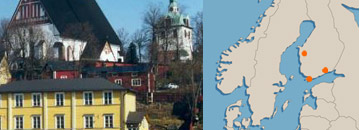
Most of the Swedish-speaking Finns live on the southern (Nyland), southwest (Åboland) and western coasts (Österbotten) and on the Åland Islands.
The Swedish presence in Finland comes at least from the XIIIth/XIVe century, when peasants and fishermen coming from Sweden settled on the opposite coast in the South and in the West. Finland belonged to the Kingdom of Sweden until 1809, after which, it has been integrated to the Russian empire, which granted Finland with the status of autonomous Grand Duchy. At that time, the language of the administration was Swedish. In 1917, Finland declared its independence and Finland's Constitution as well as the Language Act of 1992, states that Finnish and Swedish are the official languages of the Republic.
The Swedish-speaking Finns speaks the standard Swedish, but some specific features exist in the local practice. The language melody is different and the Swedish-speakers from Sweden think that, though grammatically very correct, their practice have kept some archaic features. In bilingual cities, the slang of young Swedish-speaking Finns tends to use Finnish words turned into Swedish ones. A rather fair phenomenon, knowing that the Finnish language has borrowed a huge quantity of Swedish words, turned into Finnish!
Updated, sourced data, checked on 14 October 2026 · scope : Finlande
Numerical strength
On 31 December 2025, 284,611 people had Swedish as their mother tongue recorded in the Finnish population register, against 290,161 in 20151.
Status
Under the Constitution, Finland's national languages are Finnish and Swedish; public authorities must provide for the educational, cultural and societal needs of the Finnish- and Swedish-speaking populations on equal grounds2.
Public services
Everyone has the right to use Finnish or Swedish before State authorities and those of bilingual municipalities3. A municipality is designated bilingual when the linguistic minority makes up at least 8% of the population or 3,000 people; it becomes unilingual if the minority falls below 3,000 people and below 6%; the Government sets this classification every ten years3.
Sources
- StatFin, tableau 11rm « Language according to sex by municipality, 1990-2025 » (population au 31 décembre), Statistics Finland (Tilastokeskus), 2026.
- Constitution of Finland (731/1999), traduction anglaise non officielle, section 17, Finlex, ministère de la Justice de Finlande, consulté en 2026.
- Language Act (423/2003), traduction anglaise non officielle, Finlex, ministère de la Justice de Finlande, 2003.
02. Poem
03. Linguistic description
Swedish places the definite article at the end of the noun as a suffix, while the indefinite article is the same as the word for 'one'1. It forms questions by inverting subject and verb1. Its word te ('tea') comes, as in Dutch, from Fujian Chinese1,2.
Sources
The 2003 CD had no description of this language: this text was written for the site from the sources below.
- WALS Online – Swedish, World Atlas of Language Structures, Max Planck Institute for Evolutionary Anthropology, 2013 (v2026).
- Ö. Dahl, « Tea », chapitre 138 du WALS, World Atlas of Language Structures, Max Planck Institute for Evolutionary Anthropology, 2013.
04. Cartoon
Video hosted on YouTube and published by the channel shown; its author may remove it at any time.