

01. Data about the language
Language group
Indo-European / Slavic
Area
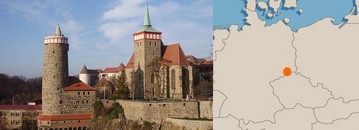
Sorbian is spoken in a number of communities in the German Federal Lands of Brandenburg and Saxony, i.e. Lower Sorbian in the district of Spree-Neisse, parts of the districts of Dahme-Spreewald and Oberspreewald-Lausitz as well as in Cottbus/Cho‰ebuz (Brandenburg), Upper Sorbian in the district of Bautzen, in the district of Niederschlesische Oberlausitz (Lower Silesian Upper Lusatia) and in Hoyerswerda (Saxony). The Sorbs virtually always form a minority in a German majority population. There are only a small number of villages with a Sorbian majority.
The Sorbians from Lusatia are the descendants of the Slavic tribes from the Elbe river, that settled in the upper and lower Lusatian area during the great migrations in the Vth century. The first historical reference to the Sorbians is found in 631, in the Fredeger's Chronicle. Their territory was conquered in the Xth century by the German feudal States, that were developping.
Updated, sourced data, checked on 14 October 2026 · scope : Allemagne (Haute-Lusace en Saxe : haut-sorabe ; Basse-Lusace au Brandebourg : bas-sorabe)
Numerical strength
There is no language census in Germany, and the last comprehensive survey of Lower Sorbian dates from 1993–19951.
Saxon public authorities cite about 60,000 Sorbs, including 20,000 Lower Sorbs in Brandenburg and 40,000 Upper Sorbs in Saxony; according to a Leipzig University study (2024), these figures for ethnic affiliation are often mistaken for speaker numbers1. The latest scholarly estimate (Lewaszkiewicz, 2014) puts the number of people able to communicate actively at no more than 8,500 for Upper Sorbian and 1,000 for Lower Sorbian1.
Lower Sorbian: the 2024 study estimates the number of competent speakers at 50 to 100, and those who learned it as a first language at fewer than 1001. The WITAJ Language Centre in Cottbus knows of 15 families in which at least one parent speaks Sorbian to the children1.
Status
Sorbian rights are governed by two state laws: in Saxony, the Act on the Rights of the Sorbs of 31 March 19994; in Brandenburg, the Sorbs/Wends Act of 7 July 1994, last amended on 5 March 2024, which recognises the Sorbs/Wends as an "equal part of the people of the State" and defines their traditional settlement area3. The final delimitation of that area in Brandenburg is still pending, after rulings of the Cottbus administrative court were appealed2.
Germany applies the European Charter for Regional or Minority Languages to Upper Sorbian in Saxony and Lower Sorbian in Brandenburg2. In September 2023, the Brandenburg Landtag decided to accept 13 additional undertakings for Lower Sorbian; the federal procedure had not been completed by early 20262.
The Foundation for the Sorbian People is funded by the Federation (three sixths), Saxony (two sixths) and Brandenburg (one sixth); a fifth funding agreement is to cover 2026–20302. Since 1 May 2025, the Civil Code allows gender-specific surname forms in accordance with Sorbian tradition2.
Public services
Saxony: within the Sorbian settlement area, everyone may use Sorbian before Saxon authorities, with the same legal effect as German and without costs or disadvantages; public signage there is to be bilingual4. The right to use Sorbian before the courts of the home districts is guaranteed, including for written applications and documents2. Each of the 42 municipalities of the settlement area receives about €5,000 a year for the extra costs of bilingualism, supported by a central service office in Hoyerswerda2. Since April 2025, a commissioner of the Saxon government coordinates Sorbian affairs across ministries2.
Brandenburg: within the settlement area, Lower Sorbian may be used before state and municipal authorities with the same legal effect as German; public buildings, streets, squares, bridges and place-name signs must be labelled in German and Lower Sorbian3. Since July 2025, several online administrative services on the service.brandenburg.de portal (driving licences, business registration, etc.) are available in Lower Sorbian2.
Education
Saxony: in January 2022, about 2,900 pupils were learning Sorbian, 2,250 of them under the bilingual "2plus" concept (16 schools) and 650 as a foreign language (11 primary schools)5. The 2plus concept was evaluated by Leipzig University, and the Sorbian Institute carried out language proficiency tests with pupils in year 82.
Brandenburg: at the Lower Sorbian Grammar School in Cottbus, Sorbian is compulsory up to the school-leaving exam; from 1994–95 to 2022–23, 1,652 pupils studied it there up to the final year1. The state programme supporting nurseries that offer Sorbian was revised in September 2025 and extended to three years (2026–2028)2. The Brandenburg University of Technology is preparing a primary-teacher training course in Sorbian in Senftenberg; secondary teachers continue to be trained at Leipzig University2.
Adults: the ZORJA immersion project took in its first group of 12 people in September 2023, for ten months of full-time courses1.
Media
Public radio and television: "MDR Sachsen – Serbski rozhłós" broadcasts 25.5 hours a week in Upper Sorbian from the Bautzen studio, and RBB broadcasts Lower Sorbian programmes from Cottbus; the "MDR Serbja" and "rbb serbski" apps bundle their Sorbian content2. A member of the Sorbian people has sat on the MDR broadcasting council since December 20212. No private programme entirely in Sorbian has been licensed in Saxony2.
Film: the Sorbian-German film network "Łužycafilm" receives about €420,000 until 2031 from structural-change funds2.
Press: the Domowina publishing house in Bautzen publishes Serbske Nowiny, Nowy Casnik and the review Rozhlad6.
Miscellaneous
Sources
- Wojto, T. ; Asmus, S. « Wie viele kompetente Niedersorbischsprecher gibt es im Jahr 2024? / How many competent speakers of Lower Sorbian are there in 2024? », Slavia Occidentalis 81/1, p. 159-168 (version bilingue), Universität Leipzig, Institut für Sorabistik, 2024.
- Achter Bericht der Bundesrepublik Deutschland gemäß Artikel 15 Absatz 1 der Europäischen Charta der Regional- oder Minderheitensprachen (Drucksache 21/6400), Deutscher Bundestag / Bundesregierung (Bundesministerium des Innern), 2026.
- Gesetz über die Ausgestaltung der Rechte der Sorben/Wenden im Land Brandenburg (Sorben/Wenden-Gesetz – SWG) du 7 juillet 1994, modifié en dernier lieu le 5 mars 2024, Land Brandenburg, BRAVORS, 2024.
- Gesetz über die Rechte der Sorben im Freistaat Sachsen (Sächsisches Sorbengesetz – SächsSorbG) du 31 mars 1999, Freistaat Sachsen, REVOSax, consulté en 2026.
- « LernSax jetzt auch in Sorbisch » (communiqué du 16 janvier 2022), Sächsisches Staatsministerium für Kultus, Medienservice Sachsen, 2022.
- Domowina-Verlag – Ludowe nakładnistwo Domowina (page d'accueil et mentions légales), Domowina-Verlag GmbH, Bautzen, consulté en 2026.
02. Poem
03. Linguistic description
Sorbian is a West Slavic language with two written forms: Upper Sorbian in Upper Lusatia (Saxony) and Lower Sorbian in Lower Lusatia (Brandenburg)2. Together with Slovene, they are the only present-day Slavic languages that productively use the dual, a grammatical number for pairs alongside singular and plural1.
Sources
The 2003 CD had no description of this language: this text was written for the site from the sources below.
- F. Marušič, R. Žaucer, « Case study: Slovenian dual », University of Nova Gorica, 2017.
- Sorbian in Germany (Mercator Wiki), Mercator European Research Centre (Fryske Akademy), 2024.
04. Cartoon
Video hosted on YouTube and published by the channel shown; its author may remove it at any time.