
01. Data about the language
Language group
Indo-European / Slavic
Area
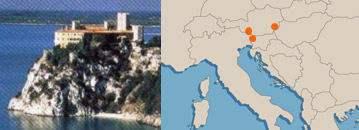
Slovene is spoken in 36 communities in the Friuli-Venezia Giulia region, viz. in Val Canale (quadrilingual: Slovene, Italian, German and Friulan), Valle di Resia, the upper Valle del Torre, the Valli del Natisono and upper Collio in the province of Udine, the upper Collio, the Carso and also Gorizia in the province of Gorizia, as well as in the entire province of Trieste excluding the coastal strip between Trieste and Slovenia's border. In other words, the Slovenes of Italy live for the most part in areas which are bilingual, or even trilingual. Slovenian community with Italian citizenship includes the provinces of Trieste, Gorizia (since the end of World War I) and Udine (since 1866, creation of Italy).
Updated, sourced data, checked on 14 October 2026 · scope : Autriche (Carinthie, Styrie) — la partie italienne n'a pas été actualisée faute de source officielle accessible
Numerical strength
Status
In Austria, the language is protected by Parts II and III (Articles 8 to 14) of the European Charter for Regional or Minority Languages in Carinthia, within its language area defined by the Ethnic Groups Act (Volksgruppengesetz)1. Federal support for the ethnic groups was doubled from 2021 and reached €7.6 million in 2023 for the Federal Chancellery alone1.
Public services
In Carinthia, 164 localities in 24 municipalities fall under the bilingual place-name rules of the Ethnic Groups Act; Slovene is an official language in 16 municipalities (145 localities) in the districts of Klagenfurt-Land, Villach-Land and Völkermarkt, and a court language in three judicial districts (Bleiburg/Pliberk, Eisenkappel/Železna Kapla, Ferlach/Borovlje)1. Half of the municipalities where Slovene is official have a bilingual information website; around a hundred forms exist in Slovene1.
Education
Carinthia: in 2023–24, 46.98% of primary pupils within the scope of the Minority Schools Act received bilingual Slovene–German teaching; across the whole Land, 22.5% of primary pupils (4,529 pupils, in 35 municipalities) took Slovene teaching, either bilingual or as a subject1. 37 crèches and kindergartens in 21 municipalities operate in Slovene (1,307 children in 2023–24)1.
Media
Since September 2022 the ORF has produced the fortnightly TV magazine "WIR | Češi, Hrvati, Magyarok, Roma, Slováci, Slovenci", broadcast on ORF 2 and ORF III in the ethnic-group languages with German subtitles; in 2024, ORF Burgenland and ORF Carinthia produced about 100 hours of television and over 4,000 hours of radio in these languages1. Since 2021 one "lead medium" per ethnic group has received specific federal funding1. For the Slovenes, this lead medium is the weekly Novice (€566,000 for 2024–25); over 66 hours of Slovene radio are broadcast each week in Carinthia, including 53.5 hours produced with radio AGORA1.
Sources
- 6. Bericht der Republik Österreich gemäß Artikel 15 Absatz 1 der Europäischen Charta der Regional- oder Minderheitensprachen (état au 1er octobre 2025), Bundeskanzleramt (Chancellerie fédérale d'Autriche), 2025.
02. Poem
Writer of poems and essays, and translator.
03. Linguistic description
Slovene is an Indo-European language, and is part of the southern group of the Slavic languages spoken in a very wide area of central-eastern Europe.
Slovenes and Czechs form westernmost branch of the Slavic world and are its only component to have direct contacts with the two other main linguistic families in Europe, the Germanic and the Neo- Latin.
Slovene language started to radically distinguish from Paleoslavic in the 9th century. The ‘BriÏinski spomeniki' ('Monuments' form Frisinga, named after the Bavarian town where they were found in 1807) are the oldest written documents known in Slovene, and are a sort of liturgical handbook. One of the most important period in this process was the Protestant Reformation, when the first books in Slovene were published by PrimoÏ Trubar. The Illuminism gave another important impulse to this process.
Nevertheless, the development of the Slovene culture went through a series of obstacles, such as the Turks invasions, the government (and oppression) of foreign aristocracies and a long social subordination, which inevitably lead to different forms of assimilation.
Slovene is the official language of the Slovene Republic and a minority language in Italy, Austria, Hungary and Croatia.
04. Cartoon
Video hosted on YouTube and published by the channel shown; its author may remove it at any time.