
01. Data about the language
Language group
Indo-European / Germanic
Area
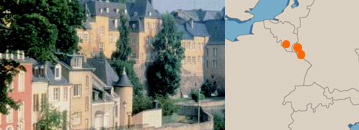
Luxembourgish is spoken in the region of Thionville/ Diddenuewen (Lorraine).
The most antique text in Old German, was written during the IXth century by the monk Otfried de Wissembourg (Otfried von Weißenburg); from North Alsace. The literate German, "Hochdeutsch", appears by the end of the XVIth century, just as in the other German-speaking regions of Europe. (language or dialect ? this is a debate). The first German edition of the Bible was printed in 1466 in Strasbourg. Alsace and Lorraine were annexed to France during the XVII and XVIII century (with one interruption between 1870&1918 when part of the region was integrated to the German Empire and 1940-44 when they were occupied by Hitler’s troops) Le plus ancien texte littéraire en vieil allemand datant du IXème siècle est l'oeuvre du moine Otfried de Wissembourg (Otfried von Weißenburg) en Alsace du Nord. L'allemand littéraire ou "Hochdeutsch" y fait son apparition au XVIème siècle comme dans les autres régions germanophones d'Europe (Langue - dialecte [Débat - ]). La première édition allemande de la Bible a été imprimée à Strasbourg en 1466. L'Alsace et la Lorraine ont été annexées à la France, l'une au XVIIème siècle et l'autre au XVIIIème siècle avec une interruption de 1870 à 1918 où une partie de la Lorraine et l'Alsace ont été réunies au deuxième Empire allemand. De 1940 à 1944, ces territoires ont été occupés par l'Allemagne nazie.
Updated, sourced data, checked on 14 October 2026 · scope : Luxembourg ; France (Moselle) ; Belgique (région d'Arlon)
Numerical strength
Luxembourg, 2021 census: Luxembourgish is the main language of 275,361 residents, 47.7% of the population, ahead of Portuguese (15.0%) and French (14.5%)1.
Status
Luxembourg: the law of 20 July 2018 makes Luxembourgish language policy a cross-cutting government approach, aimed at strengthening the importance of the language, supporting its use and study and encouraging its learning; it provides for a twenty-year action plan, evaluated every five years2. It establishes a Commissioner for the Luxembourgish language, appointed for seven years, a Centre for Luxembourgish (Zenter fir d'Lëtzebuerger Sprooch) and a Permanent Council for the Luxembourgish language of eleven experts2.
France: the Constitution states that "the language of the Republic is French" (Art. 2) and that "regional languages belong to the heritage of France" (Art. 75-1)3. France signed the European Charter for Regional or Minority Languages on 7 May 1999, but the Constitutional Council ruled that it contained clauses contrary to the Constitution6. Law no. 2021-641 of 21 May 2021 includes regional languages in the linguistic heritage protected by the Heritage Code4; the Constitutional Council struck down two of its articles, on immersion teaching and on diacritical signs in civil registers5.
Public services
Luxembourg: the Centre for Luxembourgish publishes spelling and grammar rules, develops language tools and translates official documents and communications at the ministers' request2.
Sources
- Présentation des résultats du recensement de la population 2021 : focus sur Dudelange (tableau « Langue principale », Grand-Duché), STATEC – Institut national de la statistique et des études économiques du Luxembourg, 2024.
- Loi du 20 juillet 2018 relative à la promotion de la langue luxembourgeoise (Mémorial A n° 646 du 3 août 2018), Journal officiel du Grand-Duché de Luxembourg (Legilux), 2018.
- Constitution du 4 octobre 1958 (texte intégral en vigueur), Conseil constitutionnel, consulté en 2026.
- Loi n° 2021-641 du 21 mai 2021 relative à la protection patrimoniale des langues régionales et à leur promotion (texte publié au JO n° 119 du 23 mai 2021, reproduit dans le recueil des travaux préparatoires), Légifrance ; ministère de la Culture, 2021.
- Décision n° 2021-818 DC du 21 mai 2021, Conseil constitutionnel, 2021.
- Décision n° 99-412 DC du 15 juin 1999 — Charte européenne des langues régionales ou minoritaires, Conseil constitutionnel, 1999.
02. Poem
in A short story of Literature in Luxembourgish
1994 Bibliothèque Nationale / with the support of the Centre National de Littérature
03. Linguistic description
Luxembourgish is a Germanic language of the Moselle Franconian family2. Its spelling strives to reflect pronunciation; the first official spelling, in 1946, even sought to diverge clearly from German, but it never caught on in schools1. Writing thus records the 'Eifel rule'1. A final -n is kept only before a vowel or before n, d, t, z and h; elsewhere it is dropped1. So one writes Frittendëppen ('chip pan') but Frittefett ('frying fat'), from the same word Fritten ('chips')1.
Sources
The 2003 CD had no description of this language: this text was written for the site from the sources below.
- N. D. Snoeren, M. Adda-Decker, G. Adda, « The Study of Writing Variants in an Under-resourced Language: Some Evidence from Mobile N-Deletion in Luxembourgish », LREC 2010, LIMSI-CNRS, 2010.
- Glottolog 5.3 – Moselle Franconian, Max Planck Institute for Evolutionary Anthropology, 2025.
04. Cartoon
No cartoon in this language could be found on public video platforms.