
01. Data about the language
Language group
Indo-European / Romance
Area
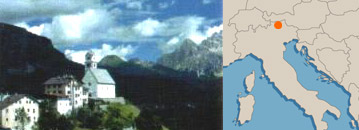
Ladin is spoken in certain valleys in the Dolomites, Val Badia, Val Marebbe, Val Gardena, Val di Fassa, Livinallongo, as well as in Cortina d'Ampezzo (located in the provinces of Trento, Belluno and Bolzano/Bozen).
The term 'Ladin' or 'Rhaeto-Romance' refers to a group of neo-Latin varieties spoken in the central and eastern Alpine regions. Three varieties can be identified: Western, Central and Eastern Ladin. Eastern Ladin is dealt with separately under Furlan. Western Ladin is spoken in the Graubhnden and Engadin areas in Switzerland. Central Ladin is spoken in certain valleys of the Dolomites. .
Updated, sourced data, checked on 14 October 2026 · scope : Italie (Haut-Adige/Tyrol du Sud, Trentin, province de Belluno)
Numerical strength
South Tyrol: in the 2024 language census (declarations of language-group affiliation), 4.41% of declarations were for the Ladin group, against 68.61% for the German and 26.98% for the Italian group2.
According to the Mercator research centre, Ladin has about 30,000 speakers, 79% of the roughly 38,000 inhabitants of the Ladin valleys (Val Badia, Gherdëina/Val Gardena, Val di Fassa, Fodom, Cortina d'Ampezzo)1.
Status
Italy has signed but not ratified the European Charter for Regional or Minority Languages; Law 482 of 15 December 1999 on historic linguistic minorities guarantees language teaching and use in local administration1.
In South Tyrol, the autonomy statute guarantees that at least one member of the Ladin group sits in the Landtag (provincial assembly), and the Ladin group may be represented in the provincial government beyond its numerical weight2.
Public services
Education
Ladin schools must provide two weekly Ladin lessons1. In Trentino, a 1990 law allows Ladin alongside Italian in nursery school in the Fassa valley, and a 1995 provincial law introduced Ladin as a subject in schools of Ladin municipalities1. Teaching materials and teacher training are provided notably by the Ofize Ladin Fascia Pedagogich (Trento) and Ladin teachers' associations1.
Miscellaneous
The Micurà de Rü cultural institute (Val Badia) publishes books and children's literature in Ladin; an Italian–Ladin dictionary and a spell checker are available online1.
Sources
- Ladin in Italy (Mercator Wiki, d'après R. Verra, The Ladin language in education in Italy, Mercator Regional Dossier, 2016), Mercator European Research Centre on Multilingualism and Language Learning (Fryske Akademy), mis à jour en 2026.
- Autonomiereport Südtirol 2025 (reprend ASTAT, « Ergebnisse Sprachgruppenzählung 2024 », astatinfo 56, décembre 2024), Eurac Research, Bozen/Bolzano, 2025.
02. Linguistic description
Ladin comes from the spoken Latin brought to the Alps by the Roman conquest; it then developed in contact with Germanic languages and later Italian1. It is written in five varieties, one per valley around the Sella massif: Badia, Gherdëina, Fassa, Fodom and Anpezo1. As early as 1833, the priest Nikolaus Bacher (Micurá de Rü) wrote a grammar that for the first time proposed a common written language for all the Ladin valleys of the Dolomites2.
Sources
The 2003 CD had no description of this language: this text was written for the site from the sources below.
- Dolomitic Ladin – language profile, Universität Innsbruck (Tradutur), 2025.
- L. Craffonara, « Nikolaus Bacher: Versuch einer deütsch-ladinischen Sprachlehre (1833) », Ladinia XVIII, Istitut Ladin Micurá de Rü, 1994.
03. Cartoon
Video hosted on YouTube and published by the channel shown; its author may remove it at any time.