

01. Data about the language
Language group
Indo-European / Celtic
Area
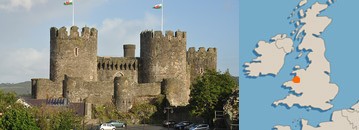
Welsh is spoken throughout Wales and by emigrants in other parts of the United Kingdom.
The Welsh language (Cymraeg) was first spoken between 400 and 700 AD and the first Welsh language poetry dates from seventh century.
It was the majority language up to the second half of the 19th century: documents from the 13th century demonstrate that Welsh was commonly used in administration, and also as the juridical and governmental language. A strong literary tradition was further bolstered by the translation of the Bible in 1588, which nowadays is still a literary reference (a modern translation was published in 1988).
The decline of the Welsh language started by the XV century, with the ascendancy of the Tudor dynasty to the throne after which English became the official language of all administrative and juridical institutions, mainly after the Act of Union of 1536.
Updated, sourced data, checked on 14 October 2026 · scope : Royaume-Uni (pays de Galles)
Numerical strength
2021 Census: 538,300 residents of Wales aged 3 and over, or 17.8%, reported being able to speak Welsh, down from 562,000 (19.0%) in 2011 and 582,400 in 20011,2. The fall is driven in particular by the decline among 3–15 year-olds1.
According to the Annual Population Survey, 828,600 people (26.9%) could speak Welsh in the year ending 31 March 2025; the Welsh Government advises caution in interpreting these figures, as their accredited official statistics status has been temporarily withheld2.
Use: according to the 2019–20 Welsh Language Use Survey, 10% of the population speak Welsh daily and more than just a few words2.
Status
The Welsh Language (Wales) Measure 2011 provides that "the Welsh language has official status in Wales", without affecting the status of English; it also creates the post of Welsh Language Commissioner3.
The "Cymraeg 2050" strategy, launched in July 2017, targets a million speakers by 2050 and a doubling, from 10% to 20%, of the share of the population speaking Welsh daily2. The Welsh Language and Education (Wales) Act 2025, which received Royal Assent on 7 July 2025, enshrines in law the target of at least a million Welsh speakers by 20504.
Public services
The 2011 Measure gives effect to official status through duties on bodies to use Welsh, the principle of equal treatment of Welsh and English, and oversight by a Welsh Language Commissioner3. Regulations adding six bodies and Special Health Authorities to the Welsh Language Standards came into force on 28 March 2025; a consultation on extending them to registered social landlords was held from June to September 20252.
Education
In 2024–25, 24.0% of Year 1 pupils were taught through the medium of Welsh; the target is 26% by 20262. The share of 7-year-olds learning Welsh as a first language rose from 22.2% in 2011–12 to 24.1% in 2024–25, and 19.8% of pupils entering secondary school (Year 7) were taught in Welsh2. Seven new Welsh-medium schools were completed in 2024–252.
The 2025 Act aims for all pupils to be at least "independent Welsh language users" by the end of compulsory schooling, and creates three statutory categories of school according to the place of Welsh4. It also creates a National Institute for Learning Welsh, whose provisions come into force on 1 August 20274.
Adults: in 2023–24, the National Centre for Learning Welsh had 18,330 learners2.
Media
Sources
- Welsh language, Wales: Census 2021, Office for National Statistics, 2022.
- Cymraeg 2050: A million Welsh speakers, Annual report 2024–25, Welsh Government / Llywodraeth Cymru, 2026.
- Welsh Language (Wales) Measure 2011, section 1, legislation.gov.uk, 2011.
- Welsh Language and Education (Wales) Act 2025, Welsh Government / Llywodraeth Cymru, 2025.
- S4C Annual Report and Statement of Accounts 2024–25, S4C (publié par GOV.UK), 2025.
02. Poem
03. Linguistic description
Welsh is a Celtic language whose sentences begin with the verb, followed by the subject and then the object1. It has a definite article but no indefinite article, and adjectives follow the noun1. Its word for tea, te, goes back like French thé to Fujian Chinese te1,2.
Sources
The 2003 CD had no description of this language: this text was written for the site from the sources below.
- WALS Online – Welsh, World Atlas of Language Structures, Max Planck Institute for Evolutionary Anthropology, 2013 (v2026).
- Ö. Dahl, « Tea », chapitre 138 du WALS, World Atlas of Language Structures, Max Planck Institute for Evolutionary Anthropology, 2013.
04. Cartoon
Video hosted on YouTube and published by the channel shown; its author may remove it at any time.