
01. Data about the language
Language group
Indo-European / Celtic
Area
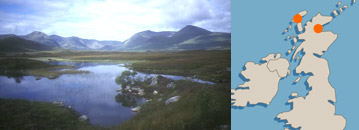
Gaelic speakers are found in all parts of Scotland, but the main concentrations are in the Western Isles, Skye and Lochalsh, Lochaber, Sutherland, Argyll and Bute, Ross and Cromarty, and Inverness. There are also Gaelic speakers in the cities of Edinburgh, Glasgow and Aberdeen..
Gaelic was imported in Scotland by the end of the Vth century AD by the Irish settlers (they were coming from the North-East of Ireland). Up to the XVIIth century Scotland and Ireland shared the same literary language, but since the language split into two distinct sorts of Gaelic. Between the IX and XIth centuries, Scottish Gaelic was shining forth as the language of Scotland's Court, monasteries... We can still consider its importance by looking up the toponomy of the region. The decay of the Gaelic language started with the wedding of Malcolm Canmore king of Scotland and princess Margaret of England (1070). Ever since English never stopped progressing in the region, and became the language of the upper classes, of trade and exchanges...
Updated, sourced data, checked on 14 October 2026 · scope : Royaume-Uni (Écosse)
Numerical strength
2022 Scottish Census: 130,161 people aged 3 and over (2.5%) have some Gaelic skills, 43,105 more than in 2011 (1.7%)1,2. About 44,000 people speak, read and write it (32,000 in 2011), and 46,000 understand it only, now the largest category1.
The largest increase was among 3–15 year-olds (+11,200); the share of under-50s among people with Gaelic skills rose from 57% to 62%1. In the Na h-Eileanan an Iar (Western Isles) constituency, 57% of residents have Gaelic skills, the highest share in Scotland1.
Status
The Scottish Languages Act 2025 recognises the status of Gaelic (s. 1); this official status came into force on 30 November 20252,3. The Act allows "areas of linguistic significance" to be designated in Gaelic communities, provides for a national strategy and standards for Gaelic, and introduces targets for the number of speakers and learners2,3.
It builds on the Gaelic Language (Scotland) Act 2005, which created the public body Bòrd na Gàidhlig and the national Gaelic language plan4.
Public services
Education
Media
Miscellaneous
The Scottish Government allocated £35.7 million in 2025 to Gaelic and Scots initiatives2.
Sources
- Gaelic and Scots in Scotland – what does the census tell us?, SPICe – Scottish Parliament Information Centre (A. Aiton, N. Sharratt), 2024.
- Growing Scotland's languages (communiqué : statut officiel du gaélique et du scots), Scottish Government, 2025.
- Scottish Languages Act 2025 (asp 10) – table des matières, legislation.gov.uk, 2025.
- Gaelic Language (Scotland) Act 2005 (asp 7) – table des matières, legislation.gov.uk, 2005.
- Gaelic Medium Education in Secondary Schools, 2025/26, Scottish Government, 2026.
- Record-breaking year for MG ALBA as Gaelic drama goes global (rapport annuel 2024/25), MG ALBA, 2025.
02. Linguistic description
Scottish Gaelic is a Celtic language of the Goidelic branch, like Irish2. Sentences begin with the verb, followed by the subject and then the object1. It has two genders and a definite article, but no indefinite article1. Yes/no questions are formed with a special form of the verb1.
Sources
The 2003 CD had no description of this language: this text was written for the site from the sources below.
- WALS Online – Gaelic (Scots), World Atlas of Language Structures, Max Planck Institute for Evolutionary Anthropology, 2013 (v2026).
- Glottolog 5.3 – Scottish Gaelic, Max Planck Institute for Evolutionary Anthropology, 2025.
03. Cartoon
Video hosted on YouTube and published by the channel shown; its author may remove it at any time.