

01. Data about the language
Language group
Finno-Ugric / Finnish
Area
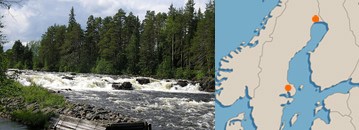
Constituting around 4 % of the total Swedish population Finnish speakers are found all over the country. However, a slight concentration in larger cities and urban areas in general is noticeable.
Finish has been spoken in Sweden for centuries : both countries were a single state for 650 years (1155-1809). During that period there were constant migrations from one side to the other of the territory. When Finland split from Sweden and was annexed by the Russian Empire, mobility continued on both sides. One difference is that, the Fine were settled in the northern parts of the country since the XIth century and they are still considered as the actual Finish speaking community of Sweden.
Updated, sourced data, checked on 14 October 2026 · scope : Suède
Status
In Sweden, Finnish, Meänkieli and Sami are covered by Part III of the European Charter for Regional or Minority Languages, each with an "administrative area"; since their introduction in 2010, these areas have grown through voluntary affiliation and included 85 municipalities and 15 regions in 20261. In these areas, individuals may use their minority language with the authorities concerned and are entitled to preschool and elderly care wholly or largely in that language1.
Public services
In these areas, individuals may use their minority language with the authorities concerned and are entitled to preschool and elderly care wholly or largely in that language1.
Education
In 2023–24, 4,561 compulsory-school pupils took mother-tongue tuition in Finnish, out of 8,278 entitled (55%); 62 students graduated from upper secondary in 2022–23 with a grade in Finnish as mother tongue1. Since 2019 preschool children have the right to develop their mother tongue, and municipalities in the administrative areas must offer, on request, a preschool place wholly or largely in Finnish1.
Media
In 2025 the Swedish public broadcasters (Sveriges Radio, SVT and UR) broadcast or provided 7,938 hours of programmes in Finnish, 4,796 of them first broadcasts; TV Finland, which relayed Finland's public broadcaster Yle, did not apply for a licence for 2026–2033 and is no longer on the terrestrial network1.
Sources
- Sweden's 9th Report to the Council of Europe under the European Charter for Regional or Minority Languages, Government Offices of Sweden (Regeringskansliet), Ministry of Culture, 2026.
02. Linguistic description
Finnish, a Finno-Ugric language, has ten or more cases, no grammatical gender and no articles, and uses postpositions rather than prepositions1. Negation is expressed by an auxiliary verb1. The word tee goes back to Fujian Chinese te, the form that Dutch traders spread across Europe1,2.
Sources
The 2003 CD had no description of this language: this text was written for the site from the sources below.
- WALS Online – Finnish, World Atlas of Language Structures, Max Planck Institute for Evolutionary Anthropology, 2013 (v2026).
- Ö. Dahl, « Tea », chapitre 138 du WALS, World Atlas of Language Structures, Max Planck Institute for Evolutionary Anthropology, 2013.
03. Cartoon
Video hosted on YouTube and published by the channel shown; its author may remove it at any time.