

01. Data about the language
Language group
Indo-European / Romance
Area
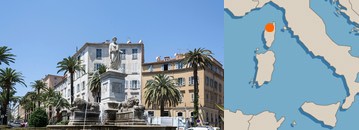
Corsican is the native language of the island of Corsica.
Corsica is nowadays a French region. Though it encountered a tormented history : conquested by the Roman empire in 259 BC, conquested by Pisa, Genova, and by France (1769), all invasions created a strong feeling of specific cultural and linguistic identity.
Updated, sourced data, checked on 14 October 2026 · scope : France (Corse)
Numerical strength
According to the sociolinguistic survey carried out by the Collectivité de Corse from 25 May to 6 July 2021 among 1,500 people, 39.1% of the adult population living in Corsica are "active speakers", i.e. between 99,000 and 112,000 people (central estimate: 105,500)1. While 65% of respondents said they "speak Corsican", only 41% answered the survey in Corsican1.
Ability by age: 67% of over-50s consider themselves able to speak Corsican, against 46% of under-40s1. Transmission: 81% of speakers learned it from their grandparents and 74% from their parents; 72% of respondents feel that Corsican is spoken less and less at home1.
Status
France: the Constitution states that "the language of the Republic is French" (Art. 2) and that "regional languages belong to the heritage of France" (Art. 75-1)4. France signed the European Charter for Regional or Minority Languages on 7 May 1999, but the Constitutional Council ruled that it contained clauses contrary to the Constitution7. Law no. 2021-641 of 21 May 2021 includes regional languages in the linguistic heritage protected by the Heritage Code5; the Constitutional Council struck down two of its articles, on immersion teaching and on diacritical signs in civil registers6.
The "Lingua 2020" plan, adopted by the Corsican Assembly in 2015, aims at the normalisation of Corsican and the achievement of bilingualism2.
Public services
France: the 2021 law allows public services to display translations into the regional language on public buildings, roads, transport infrastructure and their main communication materials5; however, the Constitutional Council held that a provision granting individuals a right to use a language other than French in their dealings with the administration was contrary to Article 2 of the Constitution6.
Education
France: the 2021 law provides that, under agreements between the State and the regions, the regional language is a subject taught within normal school hours, so that it can be offered to all pupils5.
Corsica, 2020–21: bilingual teaching covered 44.6% of primary pupils, in 156 schools, an increase of 1,600 pupils in five years; all primary pupils receive Corsican teaching2. In lower secondary, 29 schools offered bilingual teaching, followed by 3,510 pupils (about 27%); in upper secondary, only three schools ensured continuity, with 100 pupils in bilingual year 10 in 20202.
In 2022 the Executive Council of Corsica presented to the Corsican Assembly a strategy based on immersion (immersion classes and schools, immersion centres, "Case di a lingua"), after a pedagogical experiment in five public nursery schools with 312 pupils3.
Media
In 2021, 23% of the programmes of France 3 Corse ViaStella were in Corsican; a partnership agreement links the Collectivité with the radio station RCFM to broadcast Corsican, and the language's presence in the written press is considered marginal2. A partnership with four island media trained Corsican-speaking journalists through work-study contracts2.
Sources
- Enquête sociolinguistique sur la langue corse 2021 – principaux enseignements et estimation du nombre de locuteurs, Collectivité de Corse / Cullettività di Corsica, Direzzione Lingua Corsa, 2022.
- Étude sur la place de la langue corse dans la société (octobre 2021), Collectivité de Corse / Cullettività di Corsica, 2021.
- Rapport n° 2022/E3/174 « L'immersion, une stratégie au service de l'apprentissage et la pratique de la langue corse », Assemblée de Corse, Collectivité de Corse, 2022.
- Constitution du 4 octobre 1958 (texte intégral en vigueur), Conseil constitutionnel, consulté en 2026.
- Loi n° 2021-641 du 21 mai 2021 relative à la protection patrimoniale des langues régionales et à leur promotion (texte publié au JO n° 119 du 23 mai 2021, reproduit dans le recueil des travaux préparatoires), Légifrance ; ministère de la Culture, 2021.
- Décision n° 2021-818 DC du 21 mai 2021, Conseil constitutionnel, 2021.
- Décision n° 99-412 DC du 15 juin 1999 — Charte européenne des langues régionales ou minoritaires, Conseil constitutionnel, 1999.
02. Poem
03. Linguistic description
Corsican belongs to the Romance languages of central Italy, the same group as Tuscan1. Its history reaches beyond the island: Gallurese, spoken in northern Sardinia, comes from the Corsican of the Sartène area, and the speech of the island of La Maddalena was brought in the 18th century by settlers from the Bonifacio hinterland2.
Sources
The 2003 CD had no description of this language: this text was written for the site from the sources below.
- Glottolog 5.3 – Corsican, Max Planck Institute for Evolutionary Anthropology, 2025.
- E. Autelli, M. Caria, « Il sardo e le varietà sardo-còrse », Linguistik online, Universität Bern, 2025.
04. Cartoon
Video hosted on YouTube and published by the channel shown; its author may remove it at any time.