
01. Data about the language
Language group
Indo-European / Romance
Area
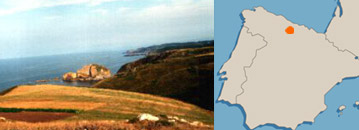
Asturian is spoken throughout the Principality of Asturias, except for the area bordering Galicia where a natural mixture of languages (Galician and Asturian) occurs. Asturian is also spoken in the North and West of the Province of Leon, but there is no official cooperation between the Asturian and Leonese regional governments as regards language promotion.
Asturian comes from the dialectal fragmentation of Latin, which occurred after the fall of the Roman Empire, and from the pre-Latin languages. The written form of Asturian exists since the Middle-Age (XIIIth and XIVth centuries). Nevertheless, the transmission of the language was oral rather than written. Nowadays, one can feel more and more a need for standardisation of the language, in order to keep it alive.
Updated, sourced data, checked on 14 October 2026 · scope : Espagne (Principauté des Asturies)
Numerical strength
The third sociolinguistic survey of Asturias, carried out in 2017 by the Euskobarómetro team of the University of the Basque Country among the population aged 16 and over, is the most recent available1. It found that 62% of Asturians speak Asturian, 38% of whom can also read or write it, and that 28% understand it only; 90% are thus at least potential speakers, up from 40% in 19831.
Transmission: 34% had Asturian as their family language in childhood (+13 points in fifteen years), 20% both languages and 42% Castilian1. For 65% of Asturians, the region's vernacular is "Asturian, bable or the Asturian language"1.
Status
Public services
Education
Media
The 1998 law requires public administrations to promote the defence of Asturian in public and private media2.
Miscellaneous
In 2017, 88% of Asturians rejected the idea that speaking Asturian means "speaking badly"1.
Sources
- IIIª Encuesta sociolingüística de Asturias – Avance de resultados (F. J. Llera Ramo, équipe Euskobarómetro), Academia de la Llingua Asturiana ; Universidad del País Vasco (UPV/EHU), 2017.
- Ley 1/1998, de 23 de marzo, de uso y promoción del bable/asturiano (texto consolidado), Boletín Oficial del Estado, 1998.
02. Poem
03. Linguistic description
Asturian belongs to the Asturo-Leonese group of Romance languages2. Its best-known feature is the 'mass neuter', so named by Dámaso Alonso in 1962: adjectives referring to a substance or an uncountable thing take an -o ending, distinct from masculine and feminine1. Thus there is claru (masculine), clara (feminine) and claro, the so-called 'continuous' form, which never occurs in the plural1.
Sources
The 2003 CD had no description of this language: this text was written for the site from the sources below.
- A. Faber, « La influyencia de la concordancia continua del asturianu nel castellanu faláu n’Asturies », Revista de Filoloxía Asturiana 15, Universidá d’Uviéu, 2015.
- Glottolog 5.3 – Asturian-Leonese-Cantabrian, Max Planck Institute for Evolutionary Anthropology, 2025.
04. Cartoon
Video hosted on YouTube and published by the channel shown; its author may remove it at any time.