

01. Data about the language
Language group
Indo-European / Romance
Area
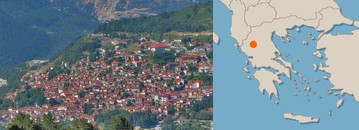
Speakers are found scattered across Thessaly, Pindus and Epirus (the mountainous regions of the Hellenic peninsula). Nowadays, most of the speakers live in adjacent cities.
Updated, sourced data, checked on 14 October 2026 · scope : Grèce
Numerical strength
There is no official estimate for Greece; the Mercator research centre cites an overall figure of 502,160 speakers across the Balkans (Ethnologue, 2017) and classifies Aromanian as critically endangered1.
Status
Greece has not signed the European Charter for Regional or Minority Languages; the authorities do not recognise the Aromanians as a distinct ethnic group and regard them as "Vlach- (or Latin-) speaking Greeks"1.
Public services
Aromanian is used neither in the courts nor in public administration1.
Education
The law makes no provision for teaching Aromanian but does not strictly forbid it; the language is not taught in state schools and cannot be studied at university (a course existed at the Aristotle University of Thessaloniki from 1996 to 1997)1. Teaching is provided by associations, often by native speakers without teacher training, for example in Athens, Veria, Metsovo, Velestino or Konitsa1.
Media
The language appears in the media only occasionally, in folk dance and song programmes1.
Miscellaneous
The Pan-Hellenic Union of Vlach Cultural Associations, founded in 1985, brings together about a hundred local associations; the Society of Aromanians of Athens, founded in late 2015, started courses in 2016 and held a workshop on writing and teaching the language in 20171.
Sources
- Aromanian in the Balkans (Mercator Wiki), Mercator European Research Centre on Multilingualism and Language Learning (Fryske Akademy), mis à jour en 2026.
02. Poem
03. Linguistic description
Aromanian belongs to the eastern branch of the Romance languages, like Romanian1,2. It is a language of dispersed communities, spoken in seven Balkan countries, from Albania to Romania via Greece and North Macedonia2. It is written in the Latin alphabet, and also in the Greek alphabet in Greece2.
Sources
The 2003 CD had no description of this language: this text was written for the site from the sources below.
- Glottolog 5.3 – Aromanian, Max Planck Institute for Evolutionary Anthropology, 2025.
- Aromanian in the Balkans (Mercator Wiki), Mercator European Research Centre (Fryske Akademy), 2024.
04. Cartoon
No cartoon in this language could be found on public video platforms.