
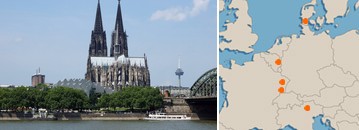

01. Data about the language
Language group
Indo-European / Germanic
Area
German is spoken in the region of Nord- Schleswig (bordering Germany).
German belongs to the Germanic language group and is spoken in several European countries, sometimes under different local forms. The written form remains nevertheless the Hoch Deutsch, the standard German. In many countries of Eastern and Central Europe, German is an international communication language.
Updated, sourced data, checked on 14 October 2026 · scope : Italie (Haut-Adige) ; France (Alsace, Moselle) — Belgique et Danemark non actualisés faute de source officielle récente accessible
Numerical strength
Italy (South Tyrol): in the 2024 language census, 68.61% of declarations were for the German language group, against 26.98% for Italian and 4.41% for Ladin1.
France (Alsace): according to the survey carried out in 2022 by the Collectivité européenne d'Alsace among 4,000 people, 73% of Alsatians consider the regional language to be the Alsatian dialect rather than standard German, but only 3% of those aged 18 and under speak Alsatian, and family transmission is "virtually non-existent"2,3.
Status
Italy: in South Tyrol, the autonomy statute protects the German and Ladin language groups; public employees must master Italian and German1.
France: the Constitution states that "the language of the Republic is French" (Art. 2) and that "regional languages belong to the heritage of France" (Art. 75-1)4. France signed the European Charter for Regional or Minority Languages on 7 May 1999, but the Constitutional Council ruled that it contained clauses contrary to the Constitution7. Law no. 2021-641 of 21 May 2021 includes regional languages in the linguistic heritage protected by the Heritage Code5; the Constitutional Council struck down two of its articles, on immersion teaching and on diacritical signs in civil registers6.
Public services
France: the 2021 law allows public services to display translations into the regional language on public buildings, roads, transport infrastructure and their main communication materials5; however, the Constitutional Council held that a provision granting individuals a right to use a language other than French in their dealings with the administration was contrary to Article 2 of the Constitution6.
Education
France: the 2021 law provides that, under agreements between the State and the regions, the regional language is a subject taught within normal school hours, so that it can be offered to all pupils5. In Alsace, the Association pour le bilinguisme en classe dès la maternelle (founded in 1990) had 890 pupils at 11 sites (plus 2 in Moselle) at the start of the 2022 school year, 7 of them schools with full immersion from nursery to the first year of primary2.
Miscellaneous
France: the Collectivité européenne d'Alsace and the Grand Est Region fund the Office for the Language and Cultures of Alsace and Moselle (OLCA), with a grant of €400,000 in 20232.
Sources
- Autonomiereport Südtirol 2025 (reprend ASTAT, « Ergebnisse Sprachgruppenzählung 2024 », astatinfo 56, décembre 2024), Eurac Research, Bozen/Bolzano, 2025.
- Rapport du Président à la Commission permanente du 15 mai 2023, n° CP-2023-4-5-2 « Financement partenarial en faveur de la langue régionale », Collectivité européenne d'Alsace, 2023.
- Restitution des assises du bilinguisme 2022, Collectivité européenne d'Alsace, 2022.
- Constitution du 4 octobre 1958 (texte intégral en vigueur), Conseil constitutionnel, consulté en 2026.
- Loi n° 2021-641 du 21 mai 2021 relative à la protection patrimoniale des langues régionales et à leur promotion (texte publié au JO n° 119 du 23 mai 2021, reproduit dans le recueil des travaux préparatoires), Légifrance ; ministère de la Culture, 2021.
- Décision n° 2021-818 DC du 21 mai 2021, Conseil constitutionnel, 2021.
- Décision n° 99-412 DC du 15 juin 1999 — Charte européenne des langues régionales ou minoritaires, Conseil constitutionnel, 1999.
02. Poem
This poem is written in the South Tyrolian dialect of Italy
03. Linguistic description
80 million people in Europe speak German. Even if there is supposed to be an official standard German, mainly dominated by Northern German, a lot of varieties exist. Those regional varieties are accepted and used in speeches and in written texts. But there are not only differences between distant German-speaking cities like Berlin and Innsbruck but also within a fairly small area, like South Tyrol.
South Tyrol is situated in the Northern part of Italy, bordering to Austria. In the Italian province with special autonomous rights around 287 000 German-speakers are living, which is around 68 percent of the population. Apart from 117 000 Italians (27,5 percent), also 18 500 Ladin-speaking people live there (4,3 percent).
Even if South Tyrolean is not a language on its own there are some words that are very rarely used in other German-speaking areas. Some of these words are also influenced by Italian:
| German | South Tyrolean | Italian | English |
|---|---|---|---|
| das Café | die Bar | il bar | cafe |
| der Personalausweis | die Identitätskarte | carta d'identitá | identity card |
| beschlagnahmen | sequestrieren | sequestrare | to confiscate, to sequestrate |
As mentioned above there are also huge differences in pronouncing words within the different valleys of South Tyrol:
| German | Passeirtal | Vinschgau |
|---|---|---|
| schiess (Schiessen) | schuiss | schiass |
| hinauf | auchn | aui |
| hinunter | ochn | oi |
Those dialects are used in private conversations. In public discussions standard German with a South Tyrolean touch is spoken.
04. Cartoon
Video hosted on YouTube and published by the channel shown; its author may remove it at any time.