

Writing: putting language in a can
"Children don't read books any more!" teachers complain; "people don't write to each other any more!" laments the Post Office. People are as passionate about public dictation contests as about spelling reforms. And how often do we hear someone pontificating on the value of this or that language according to its available literature or, more severely still, on whether a given linguistic practice even has a "writing" at all? In such a context, just try defending a language that is not written, rarely written or only recently written!
Despite the apparent diversity of these examples, and of the behaviour they give rise to, we can sense that the question of writing is central. Whether or not a language has this strange appendage – a practice that seems so natural to us in 21st-century Europe – weighs heavily in how a linguistic fact is assessed, however unconsciously or passively that judgement is accepted. It is as if writing a language suddenly ennobled it, and as if the game of classification at last revealed an objective criterion, a material proof, a specific object on which we could rely. An object, we said. Enough philosophy: it is in fact an ordinary tool, whose material nature ought to remind us every day how transient and, all things considered, how commonplace it is.
A tool-based activity like any other
It is only our overestimation of literature and the bourgeois contempt for manual work that make us almost systematically overlook the simple material nature of writing. As if "writing" – that is, in today's European culture, using either a pen filled with an ink cartridge and a thin sheet of paper, or lightly pressing plastic keys decorated with conventional symbols, a keyboard – became, by the grace of its purpose (working on language), an activity fundamentally different from laying out and melting lead to join two pieces of metal, working the steering wheel and pedals of a car to get about, or producing a masterly raspberry soufflé to treat one's friends. Only the purpose differs – or rather, the field to which we apply our ability to handle objects and tools.
Language and tool-based activity are two autonomous fields: a child's language is already formed, and learning to write affects their linguistic ability no more and no less than a cook's skill affects our ability to feel hunger. Just as the two are acquired in different ways, the complete autonomy of the abilities to speak and to handle things means that, in illness, they can be lost separately. A brain-damaged patient whose language is affected – said to be "aphasic" – may be perfectly able to repair a moped or use a keyboard or a pen. In other brain-damaged patients, language is intact, but the patient tries to light the pen and then laboriously smoke it, can no longer get dressed, lost in a heap of fabric, or picks up the telephone receiver to draw what the neuropsychiatrist asks for. They are then said to be "atechnical".
What, then, is writing, and what status should it be given? Let us say that it is a field in which, among others, our ability to make things may or may not be invested. Let us look at how it works: by convention, we decide that certain kinds of little drawings will stand for sounds (alphabets) or for words (ideograms). Then, no less conventionally, we decide how to make and reproduce these drawings, taking into account the materials we have at hand. The point is to put language into a can.1
Carrying language
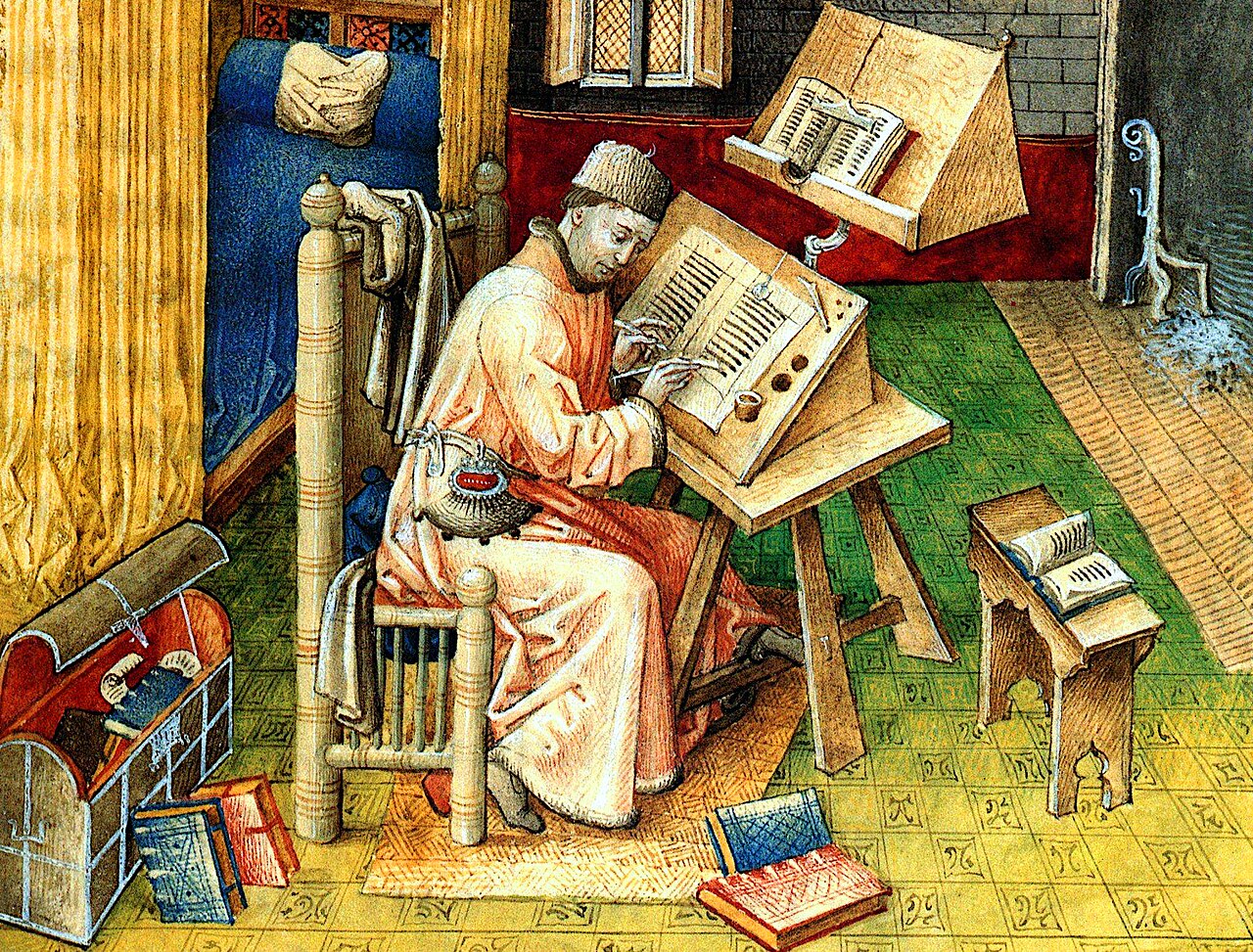
We forget that writing with a quill and reading on paper, a technology reserved for an elite in the Middle Ages, were done aloud. The invention of silent reading – where the text is no longer read aloud to give voice again to what was said elsewhere in time or space – only spread at the end of the Middle Ages2. Everything depends on context: the shapes of alphabets or the bumps of Braille cannot claim any intrinsic superiority over the tape recorder or the radio when it comes to transmitting a voice; a news report may prove more effective on television than in the press. These are technologies for transferring thought, for transferring language. In every case, a technology solves the problems specific to its own field3: is the message to be sent quickly? Confidentially? To large numbers? Is it meant to travel through time? Through space? From the point of view of technique and tools, one does not "write" a tombstone in the same way as a note to a colleague. A Post-it is not meant to last for generations.
Any concern about a reform of writing or of education must therefore include a reflection on material aspects, on the technological constraints that govern how the message is made: the German umlaut comes from technical laziness. Copyist monks, tired of reproducing the 'e' joined to the 'o' in 'œ', a frequent occurrence, ended up drawing a small 'e' above the 'o' and then, perfecting their technique, found the two dots '¨' even more 'economical'. The unkempt spelling of today's text messages owes more to the size of mobile phone keypads and the cramped space of the underground than to any contempt young people may have for works that had the good fortune to be preserved on sheets of paper bound in cardboard – let alone to the failure of the authoritarian policies of spelling "normalisation" that our first years of school represent, or to some embryonic rebellious urge to destroy the language. Here as elsewhere, one may be conservative or revolutionary; the main thing is not to mistake what is at stake.
First a technique and a manufacturing process, writing is the name given to the technologies that preserve language. But language is not the only thing carried along in this process. History – or rather our capacity to have one –, desire, value, freedom – or rather the system by which we manage them – are also inscribed, often as stowaways, in our way of doing things just as much as in our way of saying them.
Politics and law in writing
How can we fail to see the wish to refer to Latin, a presentable language held in high esteem in Europe, when French writes [dwa] 'doigt' (finger; Latin digitus), or the wish for pan-Scandinavian rapprochement when, after the Second World War, the Danes abandoned the 'ö' and the 'aa', no doubt too German, in favour of the very Nordic 'ø' and 'å'? It is still the powers of Rome and Constantinople that clash when it comes to writing Serbo-Croatian4, and Turkish might still be written in the Arabic alphabet had Atatürk admired the French Revolution and its idea of modernity and secularism a little less. Here again, the spoken language itself is hardly concerned.
We can also sense that a capital letter always lends a little sacredness to the literary drawing or to what it preserves, that a handwritten letter in cursive does not make the same thing as an e-mail in Courier, and that Beijing is less fanciful than Peking5. In a Hungarian classroom, the dunce may see his surname struck with a lower-case initial for a longer or shorter time depending on the seriousness of his fault. "Faute", the French word for fault, refers as much to sin as to a mistake in the letters used to preserve language. In Judaism, the name of God is not written with all its letters6, runes eventually took on an almost religious role, and in many legal systems a fax or an e-mail has no legal value compared with paper, pen and ink. The questions of value, desire, censorship and price, which Freud's psychoanalysis for example addresses, thus show themselves in the act of writing – which, as we can see, no longer concerns our ability to speak.
Stating grammar by writing
Finally, writing also reveals a kind of established knowledge about language itself: we leave spaces between groups of symbols to separate what traditional grammar, most imprudently, takes to be a word. The distinction linguists draw between prepositions and postpositions on the one hand and declension on the other owes more to the fact that, historically and by convention, people got into the habit of lifting the stylus, the quill or the chisel between certain groups of letters and not between others. It is hard to see what grammatically distinguishes the use of a preposition from that of a case ending, except that a material blank detaches at the head what it attaches at the tail.
| French | Finnish | English |
|---|---|---|
| Vers la maison | talolle | towards the house |
| Dans la maison | talossa | in the house |
| Sur la maison | talolla | on the house |
Writing, as it makes language, thus also includes the discourse held about language, the linguistic knowledge of the period that set its conventions. The accent on 'à' in French "à demain !" (see you tomorrow!) reflects an analysis, right or wrong, of how the language works: the category 'preposition' must be marked as such to distinguish it from the verb 'a' in "il a un chien" (he has a dog).
Let’s calm down…
We have no shortage of technical tricks for making the message, according to our purposes of the moment and the material resources available to move it, reproduce it, cast it, broadcast it, preserve it, and so on. If "writing" is the name we give to the activity of working on, of making language, it is hard to see why we should give more – or less – importance to any one of the historical conditions under which it is carried out. The alphabet, a system of small symbols to be reproduced with keys or a pointed object, on a cathode-ray tube or a flat surface, is not the alpha and omega, the unsurpassable horizon, the final answer to our need to free ourselves from the concrete and immediate conditions in which a message is sent: a mouth and an ear, sending and receiving waves that travel no further than 50 metres and that we need to be able to reproduce.
And there are, after all, many ways of being illiterate: a computer can be just as esoteric as Devanagari or boustrophedon, Ogham or cuneiform. The European believer of the Renaissance "read" a cathedral at first sight, whereas today only scholars can decipher precisely the message drawn, carved and placed on the building. A writer is first of all a maker, a worker of language, who rubs out, crosses out and draws arrows on a flat surface or, today, copies, pastes and rearranges paragraphs. The torn-up pages of the one echo the "delete" key of the other.
It is therefore up to us to take a calm look at the question of writing in general: to sort out, among the choices to be made, what belongs first to technique, then to language, then to history and law, and finally to the historically established knowledge inscribed in writing conventions. Changing the technique, the spelling, the alphabet or the system of representation, or the material devices available (keyboard and screen, quill, ink and paper, etc.) does not necessarily mean changing the language itself – rather the idea we have of it, which is another story altogether. The stakes for education policy are enormous, and thorough reflection is needed to put writing in its rightful place and to discard it, once and for all, as a criterion for judging any particular linguistic practice.
Notes
- Thus the signature succeeded the spoken word as a pledge: at a time when travel was dangerous and exhausting, an available technology had to be used to spare witnesses their perilous task once certified transactions spread over wider areas. ↩
- Writing, as a technology, then moves from the domain of declaration (to be reproduced elsewhere: think of the bailiffs or griots who re-proclaimed what the sovereign had said, in public squares and in various places) to that of conversation (to be reproduced elsewhere, but this time for a particular person or group), thereby bringing exchange and interlocution into the very material nature of reproduction. Consider cryptography and data protection on computer networks, the technology of the registered envelope, or samizdat, to gauge the importance of this introduction of the other into the technologies applied to language. ↩
- This shows how ambiguous the notion of "popular literature" or "oral literature" is: in a small geographical area, in a society where social ties are strong enough, there is no need for registers, punched cards or papyrus. Any human brain is enough to store the message. It is the wish to expand and spread messages – not always free of imperialism – that leads to the use of the technique of writing. ↩
- The Latin alphabet for writing what, after the fact, thus becomes Croatian, and Cyrillic for Serbian. ↩
- Yet each is simply a standardised way of writing Chinese, one Chinese, the other French. ↩
- A sacralisation that the Hebrew writing system, reflecting the consonantal system of Semitic languages, accommodates very well. ↩