
Definitions · 4/6
Languages or dialects?
Nineteenth century linguists used the same methods as zoologists and botanists to study language phenomena. They thought that languages, just like animal or vegetal species, could be classified together in language families, groups and sub-groups, etc, depending on their aspect, ways of functioning or alleged origins.
The notions of languages and dialects emerged from that out-of-date conception. Thus a dialect is defined as a sub-division in a given linguistic group, i.e. it is characterised by linguistic uses that can be attached to a wider linguistic ensemble for which there usually exists a so-called standard code that regulates written uses. According to such an approach, Bavarian is a dialect of German spoken in Bavaria, just like Alsatian in Alsace;
likewise, Walloon and Picard are dialects of French.
This idea, in spite of the fact that it is often summoned up, has been disproved by modern studies on language facts. Indeed, with such a conception, where should the limit be?
Does it suffice to write, that is to use tools to jot down language use, in order to eventually allow the transmission of oral messages through time and space, for written use to become, to be considered as a language? In that case, any language use, including individual language, can be called 'language'. But if every utterance can be called 'language' the word loses all relevance and explanatory strength.
Let us consider the issue from another angle. What makes the words and sounds I use actual language, i.e. a human system that relates reality and the words I use to express that reality, is an altogether different phenomenon from the phenomenon according which the words and sounds that I use are perceived by others as being Welsh or Portuguese .
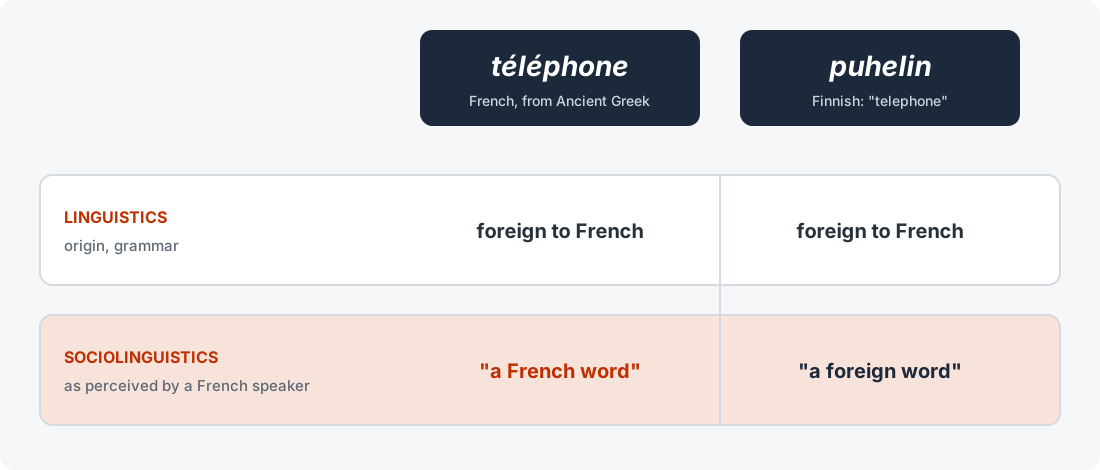
The first phenomenon can be studied by linguists, who will analyse the way phonemes and words function, the system they constitute, and the way they are ordered together. The perception, or rather the identification of this system as being a colloquial or foreign system, a contemporary or ancient system, a slang or a prestigious variety, has mainly to do with issues of belonging, of identity, of processes of unification or separation, and as such will be studied by sociolinguists who focus on language acts as resulting from social phenomena of exchange and interaction in time, space and specific contexts.
In such approaches, the words 'language' and 'dialect' become irrelevant. The issue is no longer to classify fossil species and to study their mutual relationships, but rather to understand and report on these never-ended and always re-negotiated processes whereby one marks their own practice or, conversely, marks different practices as other. The word 'téléphone' is accepted, labelled, as a French word by a French speaker. The word 'puhelin', meaning telephone in Finnish, is perceived as a foreign word. Yet, Ancient Greek, wherefore 'telephone' came, is grammatically as foreign to French as Finnish can be. Thus, historical, geographical or social mechanisms of labelisation of linguistic practice have nothing to do with linguistics itself, and actually rather result from politics in its broadest sense, i.e. the whole set of relationships established between different groups. By contrast, the notion of 'standard language', i.e. the linguistic practice adopted by a given group as its own, can be considered as the common linguistic contract made by a group of speakers, regardless of the obvious language variations that exist from one person to the other, between different places and between generations. Grammatical forms that seem archaic or fossilised, different accents, can still be constitutive of the same language, e.g. French. Linguistic heterogeneity is not synonymous with sociolinguistic difference. Thus, in French, expressions like 'j'ai pas faim' or 'je n'ai pas faim' (both meaning 'I am not hungry), despite the presence or absence of the particle of negation 'ne/n'', are still considered as linguistic productions in French (the difference is one of language register).
This contract made between speakers of one group to adopt a standard use can have a variety of origins:
*Standard Italian is based on a variety from the north of Italy just like standard Breton is based on a variety from the north of Brittany.
*Standard German results from a synthesis of various German varieties; likewise, standard Occitan is based on language uses throughout the Occitan area.
*One of the written forms of standard Greek, the katharevoussa, is based upon a group of practices descending from the Ancient Greek varieties of the Attic Plain!
Conversely, the standard language of a given group can also have nothing to do with the linguistic practices it 'standardises'. Thus, it is possible that, in particular with minority languages, speakers do no use the standard variety 'corresponding' to their practices during in-group communication because they do not command, or because its use is forbidden or stigmatised. For instance, speakers of different varieties of Breton often speak French rather than standard Breton together.
Therefore, one must not talk of languages or dialects but rather of language practices that can, or not, be accepted as a 'standard' by more or less large proportions of a given population, in a given place, at a given time and for a given class. The legitimacy of such a consensus has to do with the speakers' will.
The agreement to adopt a standard language does not refer to a linguistic but to a political process. The resulting 'contract', like all political phenomena, can be the product of a democratic or an authoritarian process. Speakers ought to be enabled to democratically choose their standard variety and conditions should be gathered so that the 'voting process' could be fair, and so that there could be a permanent, ongoing debate.